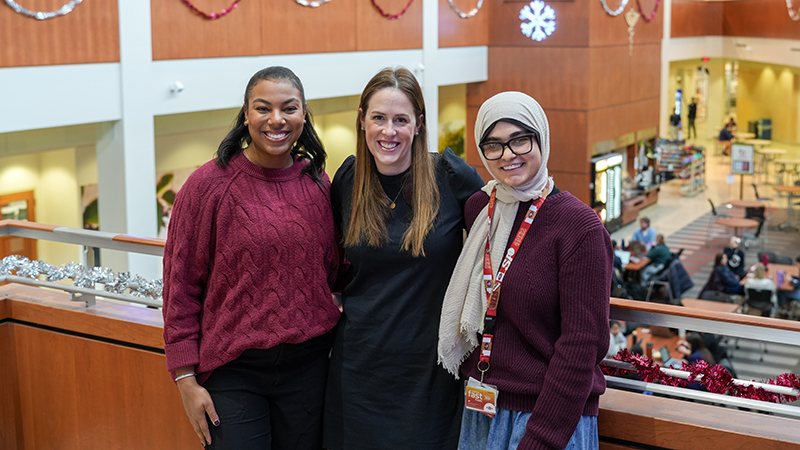
The Pediatric Interest Group (PIG) is a student-led organization for medical students who are interested in pediatrics. It offers opportunities to learn about pediatric specialties through a range of programs including noon talks, physician shadowing, and special events. Last year, PIG gained new ground thanks to the collaborative effort of student leaders, faculty liaisons, department leadership, and faculty members. At the end of 2025, PIG had a total of 125 interested students with 40 new first-year members, a reflection of the department’s growing investment in early pediatric exposure.
“We would not have the interest in pediatrics that we do without the department’s support,” said Eileen Cowan, MD, associate professor in the Division of Neonatology and Newborn Nursery and pediatric Phase 1 pre-clerkship director. “I am so excited and impressed with how quickly PIG has grown. I am humbled by how generous department leaders and faculty have been, and it has been amazing to see how much it helps.”
That growth is driven in large part by a shared leadership model between students and faculty. PIG is led by two medical students who traditionally serve a one-year term from the second semester of their first year to the first semester of their second year. The student leaders apply for the position and are selected by their peers. Medical students Morgan Guest and Samiah Ziadeh are the current student leaders nearing the end of their first term.
While Guest and Ziadeh lead the group in planning and executing the noon talks and larger semester events, they also receive support from Cowan, three faculty liaisons who serve as undergraduate medical education leaders, and administrative staff: Laura Chen, MD, assistant professor in the Division of Hospital Medicine and Complex Care; Dominic Co, MD, PhD, associate professor in the Division of Allergy, Immunology, and Rheumatology; Kirstin Nackers, MD, associate professor in the Division of Hospital Medicine and Complex Care; and Tori Benson, undergraduate medical education program coordinator.
“The collaboration among all these individuals represents what we see in medicine with team-based care,” Guest explained. “We are communicating often, and that makes it easier in terms of planning events.”
The group’s current momentum was preceded by a period of disruption during the COVID-19 pandemic. It had been difficult for students to gather consistently, leading to challenges as student leadership transitioned from year to year. Department leadership recognized this gap and identified the need for more continuity and support.
Cowan took on the responsibility of not only getting more pediatrics into the medical school curriculum but also encouraging department faculty members to get involved in the medical school and students involved in the department. PIG was central to these efforts.
“This year, I felt this big momentum to have more faculty involved, more students involved, and there has been a lot of interest in pediatrics that has been drummed up by the department being more present and offering more events,” Cowan explained.
PIG hosts one or two large events each semester that give students opportunities to network with faculty and gain hands-on experience working with pediatric patients. Recently, events have included Meet the Department of Pediatrics and Night at the Children’s Hospital.
Meet the Department of Pediatrics featured talks from John Williams, MD, department chair, professor in the Division of Infectious Diseases; Dan Sklansky, MD, associate professor in the Division of Hospital Medicine and Complex Care and residency program director; and the faculty liaisons.
“Having Dr. Williams and Dr. Sklansky speak was really important to us as students, just to see people who you think are in super powerful positions talk about how they were one of us at some point,” Ziadeh said. “They both really highlighted how their own experiences as students progressed into their current roles as leaders.”
Following the talks, students and faculty members participated in a “speed dating” event, with stations representing various divisions within the department. Students rotated through five-minute sessions, with four to five students at each table.
“Everyone was so great, and sometimes it was hard to get students to move on to the next round with how engaged they were,” Ziadeh reflected.
In spring 2025, PIG hosted its Night at the Children’s Hospital, an event that will return this year. Residents and faculty members brought in their own children so students could practice clinical skills on them, including ear examinations and developmental and neurovascular exams. Students also received a tour of American Family Children’s Hospital.
“It was the first time we were able to interact with children in a controlled clinical environment,” Guest said. “I really enjoyed being able to interact with the children and put all the pieces together.”
These events are designed to give the department a forward-facing presence within the medical school. Research has shown that students choose specialties based on early exposure to that specialty. Even the smallest interactions with faculty members make a difference, such as connecting at events, shadowing, or attending a talk.
Here in Wisconsin, the influence of PIG on future pediatricians is exemplified by the experiences of the student leaders. Both Guest and Ziadeh described early interactions with pediatricians that sparked their interest in the field and ultimately led them to join PIG.
“I think your first concept or idea of health comes from when you are a child. Having representation in that interaction is really important. I never had a doctor who looked like me. I think that does impact how you view your own health. Having a positive influence from an early age and having physicians who really care about your health can impact how you care for your body as an adult,” Guest explained. “That drove me to want to be more engaged in PIG from an early start in medical school. I did not know exactly, and still do not, what career I want to get into, but I knew pediatrics was something I was passionate about.”
Ziadeh shared a similar early experience that influenced her interest in pediatrics.
“On a more personal level, I had a lot of pediatricians when I was younger, and I was lucky enough to have a great outcome. I just remember the emotional experience that came out of that. I remember how great my doctors made me feel when they said, ‘We don’t know exactly what is wrong with you, but that’s what makes you special, and that’s why we are going to work together to figure it out.’ That has really carried with me since and is something going into medical school that I wanted to be on the other side of,” she said.
While these early experiences drew them to PIG, their year in leadership further shaped their personal and professional growth.
“My interest has only gotten stronger,” Ziadeh said. “In terms of things that have changed, I would say from an academic standpoint, I was able to dive into research through a Shapiro project with mentors Dr. Neil Munjal and Dr. Jesse Boyett Anderson.” Ziadeh added that the experience helped her solidify a desire to pair clinical and research work.
Guest shared that forming relationships with faculty was one of the most influential aspects of her experience.
“I shadowed Dr. Eileen Cowan and Dr. Adam Bauer in the NICU and loved it. I think being able to form those connections and not be intimidated by the faculty has been really helpful,” she said. “You go into medical school and think thoughts like ‘do I belong here?’. Being in this position has allowed me to make more connections with my peers, and with faculty. It has made medical school more approachable. It has prepared me to be a more successful doctor, leader, and team member.”
The opportunities offered through PIG benefit not only its student leaders but also medical students across all levels. Looking ahead to 2026, the group plans to continue hosting noon talks with pediatric specialists and offering signature events such as Night at the Children’s Hospital and Meet the Department of Pediatrics. The group also hopes to introduce a procedure fair in the spring.
In response to the national push to keep students engaged in specialties throughout their medical training, PIG plans to expand programming for third- and fourth-year medical students. That means Guest and Ziadeh have the opportunity to continue inspiring their classmates about a specialty they love while a new class of leaders enters PIG leadership.