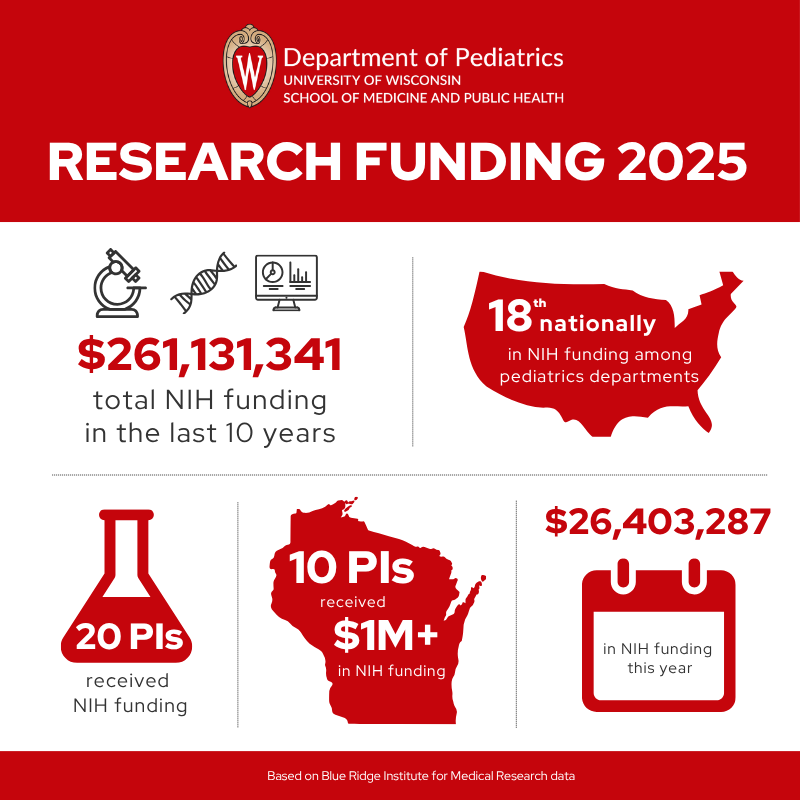
Last year, the Department of Pediatrics received more than $26.4 million in research funding from the National Institutes of Health (NIH), according to the Blue Ridge Institute for Medical Research. This funding, more than $1.3 million than it received the previous year, supports research and scientific discovery that will help improve the health and lives of children in Wisconsin and beyond. The department is ranked 18th nationally among pediatrics departments receiving NIH funding and has ranked in the Top 20 since 2015.
 “Despite a challenging year for science, our researchers continue to devise novel ideas and assemble innovative teams and strategies to write compelling and successful grant proposals,” said James (Jim) Gern, MD, professor, Division of Allergy, Immunology, and Rheumatology, and vice chair of research for the Department of Pediatrics.
In the last decade, the department has received more than a quarter of a billion dollars — $261,131,341 — from the NIH.
“The department’s ongoing research success is indicative of the commitment of so many people on our team, including PIs, scientists, trainees, student researchers, and our dedicated research administration staff,” Gern added. “They work together every day to pursue groundbreaking science and scholarly work that will promote child health, prevent disease, and help bring new cures and treatments to our patients.”
Some of the new projects led by faculty researchers who received NIH funding in the latest funding cycle include the following:
- Ryan Coller, MD, MPH, associate professor and chief, Division of Hospital Medicine and Complex Care, received an R01 award from the Eunice Kennedy Shriver National Institute of Child Health and Human Development for his project, “Caregiving Network Contribution to Children with Medical Complexity’s Health.”
- Anthony (Tony) Garcia-Prats, MD, MSc, PhD, associate professor, Divisions of General Pediatrics and Adolescent Medicine and Global Pediatrics, received a U01 award from the National Institute of Allergy and Infectious Diseases for his project, “Re-evaluating the Duration in Children of TB Treatment (REDUCE TB): A Phase 2 Duration Randomized Trial.”
- Matthew Harer, MD, associate professor, Division of Neonatology and Newborn Nursery, received an R01 award from the Eunice Kennedy Shriver National Institute of Child Health and Human Development for his project, “Optimizing Caffeine Therapy for Hypoxia in Preterm Neonates: A Randomized Trial Assessing Efficacy, Acute Kidney and Brain Injury, Safety, and Pharmacokinetics.”
- Sima Ramratnam, MD, MPH, associate professor, Division of Allergy, Immunology, and Rheumatology, received a K08 award from the National Heart, Lung, and Blood Institute for her project, “Interactions Between Genetics, Air Pollution, and Preschool-Onset Childhood Asthma.”
- Ellen Wald, MD, professor, Division of Infectious Diseases, received an R21 award from the National Institute of Mental Health for her project, “Feasibility of a Study to Determine the Incidence, Spectrum, Course, and Outcome of Pediatric Acute-Onset Neuropsychiatric Syndrome (PANS) in a Diverse Group of Children.”
Research funding during the department’s 2025 fiscal year (July 1, 2024–June 30, 2025) totaled $41.93 million. In addition to NIH funding, awards were granted from federal, industry, non-profit, state, institutional, and philanthropic sources. Read more about the department’s research success in its 2025 Annual Report.
The NIH is the primary federal agency conducting and supporting basic, clinical, and translational medical research and is investigating the causes, treatments, and cures for both common and rare diseases. Since 2006, the Blue Ridge Institute for Medical Research (BRIMR) has published rankings of institutions, departments, and investigators based on the funding they receive from the NIH.