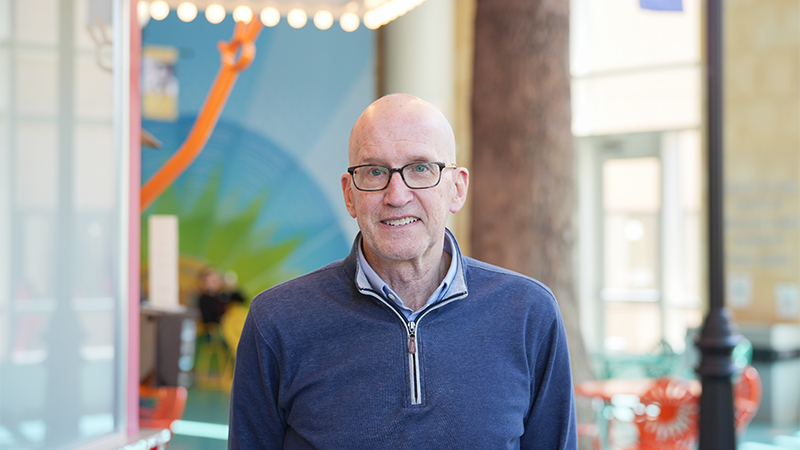
Your “dream job”? Many people hold that in mind and then try to find one as close as possible to it. David Bernhardt, MD, professor in the Division of General Pediatrics and Adolescent Medicine, with a joint appointment in the Department of Orthopedics and Rehabilitation, is one of those extraordinarily rare few who found his on the first try. Bernhardt specializes in primary care sports medicine and is the director of the Primary Care Sports Medicine Fellowship. He is the team physician for the University of Wisconsin Athletics Department, providing medical coverage for Badger men’s basketball and women’s volleyball, as well as for men’s and women’s cross country and track. And now, after 32 years doing the work he has loved, Bernhardt will step away into a deserved retirement on June 30.
A Madison native, Bernhardt decided in high school that he wanted to be a physician. “I kind of always knew I wanted to be a physician,” he said, “because my dad was a physician, and I admired what he did for patients. So I followed that path to become one.” Bernhardt also knew at that time that he wanted to be a sports medicine doctor.
While attending the then University of Wisconsin Medical School, he almost made a detour. In rotations, he found that he just did not enjoy orthopedic surgery, and at that time, that was the route many people took into sports medicine. “There were lifestyle reasons,” Bernhardt explained, “but the biggest reason was that the patients are so often asleep, and I enjoyed interacting with patients and caring for them in clinic. However, my very next rotation was pediatrics, which I loved.”
Serendipitously, he learned that Greg Landry was in the Department of Pediatrics. He was a general pediatrician primary care sports medicine doctor and the head team physician for UW athletics. “He had what I would call a dream job,” Bernhardt recalled.
“Right place, right time” magic manifested for Bernhardt when Landry offered him the opportunity to become the third-ever fellow for the Nathan Smith Postgraduate Sports and Adolescent Medicine Fellowship, which allowed him to train in primary care sports medicine at the University of Wisconsin. “And then he hired me into my dream job,” Bernhardt said.
Bernhardt’s patients include many outside UW athletics because of his three different hats of clinical practice. He is a general pediatrician at the UW Health clinic at 20 S. Park, where he sees patients from newborn to around 23 years of age. There, he addresses all the problems typically seen in pediatrics. He wears a second hat as the team physician for UW athletics, and his third practice is his job in primary care sports medicine, where he cares for young and older athletes.
“These patients are in high school, in college sports, and the occasional professional athlete,” he explained. “I also take care of the LOVB Madison, the professional volleyball team. And I take care of the typical recreational athlete and the old person who has arthritis.”
One thing Bernhardt always promotes to athletes and non-athletes alike is exercise. “We’ve had a mantra, first promoted by the American College of Sports Medicine, that exercise is medicine,” he said, “which means we should actually treat every patient as an athlete — trying to promote exercise as a part of a treatment plan.” Related to that, he uses exercise as treatment for kids he sees in his pediatric practice who have anxiety or depression. “I really try to emphasize that it’s important that they get out and move,” he said. “It doesn’t matter what they do — Frisbee, hiking, bike rides — I want them moving every day.”
After 32 years, David Bernhardt still loves his work, but he’s ready to try something new. He will retire on June 30.
Five Questions for David Bernhardt
How has your career surprised you, compared to how you had expected it to develop when you began?
I wanted to be a physician and wanted to go into sports medicine. The surprise was that I really loved my pediatrics rotation. I loved the residents I was working with, I loved the faculty who were teaching — the residents and the faculty wanted to teach, they respected my opinion. They made me feel that I was an important contributor to their team, so right away I just loved the whole pediatric part of medical school and medical education. The further surprise was that Greg Landry was in the Department of Pediatrics He offered me the sports medicine fellowship and eventually, my dream job. It was what I had expected to do, but via a different path.
What do you consider to be your biggest achievement?
I think that I’m a better doctor now than when I started, which is likely related to professional development in my wanting to learn the human aspects of being the best physician — as much or more so than knowing the science. I don’t think you get the training in medical school about how to be as compassionate and curious as you really need to be. In school, you learn to gather information, you learn how to do a physical exam, develop a differential diagnosis, but I think you miss the human part of being a doctor. So, I feel that my development there is my biggest achievement.
What has been your largest obstacle to overcome?
The constant tug of the job and wanting to do more for our patients, at the same time knowing our limits related to time and resources, as well as the taxing nature of our job in so many parts of our own lives.
What advice would you offer to new physicians just starting out?
I would stress the importance of work-life balance and making your own wellness and your own family a priority. I would also suggest continuing to expand your craft as a physician, thinking of yourself as a compassionate caretaker, good listener. And be curious: have a conversation with your patients similar to meeting a person at a coffeeshop or the terrace rather than just trying to get information doing a physical and telling them what to do.
Do you have specific plans for your retirement?
I’ll figure it out as I go: some mix of volunteer work, learning new things, travel, exercise, and seeing more of my kids, who live in Colorado.
Photo by Kate Feldt/Department of Pediatrics