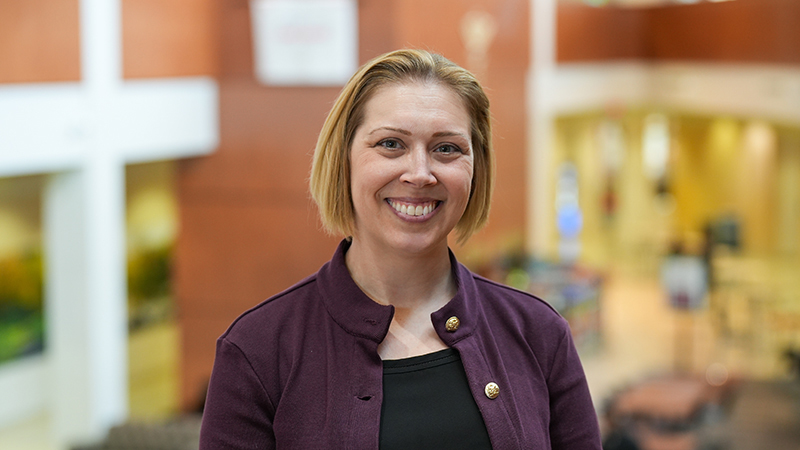
On April 1, the Department of Pediatrics welcomed Cynthia (Cindy) Ortinau, MD, MSCI, visiting associate professor, as the new chief of the Division of Neonatology and Newborn Nursery and the Alfred Dorrance Daniels Professor on Diseases of Children. Ortinau comes to the division from the Washington University School of Medicine in St. Louis, where she was on the pediatrics faculty since 2016 and associate professor in the Division of Newborn Medicine since 2024. An internationally renowned expert in neonatal neurology and neurodevelopment, Ortinau’s special focus is brain development and brain injury related to congenital heart disease.
A leader in both clinical and research initiatives, Ortinau’s work has included the system-wide design and implementation of a newborn pulse oximetry screening program for all newborn nurseries within the Barnes-Jewish Hospital System, the development of a neonatal MRI program, and implementation of a neonatology consult service for newborns with heart conditions. Her team’s work has acquired funding from the National Institutes of Health and foundations. She also serves as co-chair of the Cardiac Neurodevelopmental Outcome Collaborative, a consortium of more than 50 institutions studying cardiac neurodevelopmental outcomes, and dedicated to determining and implementing best practices of appropriate services for those affected.
Ortinau’s research interests will align strongly with those of other Department of Pediatrics scientists conducting neurodevelopment investigations. Her research interests will also parallel and intersect with the expected growth of the department’s cardiac program through the Forward Pediatric Alliance. This strategic collaboration between UW Health and Children’s Wisconsin, seeks to enhance pediatric cardiac care and adult congenital heart care. Ortinau looks forward to being able to work together with families and providers across the state to provide care in the location that’s optimal for them, especially for long-term developmental care.
Ortinau is also committed to training the next generation. She has mentored trainees at all levels of medical education and believes strongly in the essential benefits of effective mentoring. In her new position, Ortinau will seek to continue to promote a culture in the Division of Neonatology and Newborn Nursey that values excellence across clinical practice, education, research, and advocacy.
Get to know Ortinau: read her online profile, visit the Cardiac Neurodevelopmental Outcome Collaborative, which she co-chairs, and read the Q&A below.
Your hometown?
St. Louis, Missouri
Your previous position?
Associate professor in the Division of Newborn Medicine, Department of Pediatrics at Washington University in St. Louis
Why did you choose the field of pediatrics?
I love working with kids! They are amazingly resilient and they tell you exactly what they think. I chose neonatology because of the ability to care for an entire family at a very critical time in their newborn’s life.
What attracted you to UW–Madison?
The collaborative culture, focus on community, and emphasis on educating the next generation.
What are you most excited to start working on as chief of the Division of Neonatology & Newborn Nursery?
I’m very eager to help with the Forward Pediatric Alliance. It is a really exciting undertaking that uses a collaborative, multidisciplinary approach to optimize care for babies with congenital heart disease — a heart condition that babies are born with.
Do you have ongoing research? If so, how will you continue your efforts?
Yes, my research focuses on understanding the causes of developmental differences for children with congenital heart disease. We know that their neurodevelopment (how they move, think, and learn) can be different from other children. We also know that their brains grow and develop differently, even before they are born, which is likely why they have developmental differences. However, we don’t really understand what makes their brains develop differently before birth. A major goal of my research is to figure that out. Ultimately, I want to be able to use that information to protect each baby’s brain so that they can reach their full developmental potential.
I will be continuing my research by finishing ongoing studies and hopefully starting a new one shortly after I arrive. The goal of that project will be to understand how changes in heart and brain development might be affected by the placenta, which also develops differently for pregnancies with fetal congenital heart disease.
How do you think the role of division chief will influence your goals as a physician?
I have always been passionate about teaching and mentoring, but I think this role will allow me to increase my focus in those areas and contribute to the career development of our faculty more broadly. This is really exciting for me and something I am very much looking forward to!
What’s something interesting about your areas of expertise you can share that will make us sound smarter during video chats and parties?
In the last trimester of pregnancy, the weight of a baby’s brain nearly triples.
What is the last book you read?
This question made me smile because every night my husband asks me what I’m reading. My response is always “a love story” — I am a huge fan of rom-coms.
What is your favorite food?
Ice cream
Do you have a secret talent?
I’m a pretty decent pastry chef. I used to have a job making and decorating wedding cakes.
What are some of your hobbies and other interests?
Gardening and cooking are my two biggest hobbies, but I also love reading, doing anything outdoors, and hanging out with my husband and our adorable cat.
Photo by Kate Feldt/Department of Pediatrics
Article updated on 5/7/2026