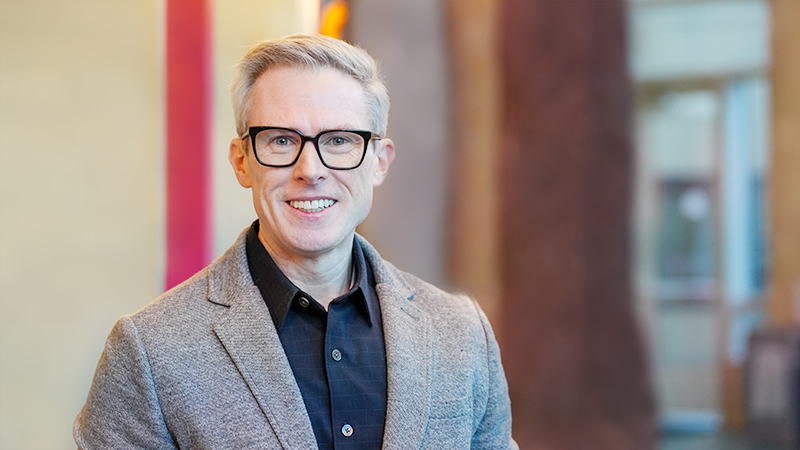
On January 1, the University of Wisconsin Department of Pediatrics elevated a well-established faculty member to the role of chief of the Division of Gastroenterology, Hepatology, and Nutrition. Daniel O’Connell, MD, associate professor in that division, had served as interim chief since August 2023. In addition, O’Connell was named the inaugural vice chair of pediatric ambulatory specialty care.
He is an expert in pediatric inflammatory bowel disease and since 2016 has served as the medical director of the pediatric subspecialty clinics at UW Health Kids. In this capacity, he oversees both medical and surgical subspecialty ambulatory operations, involving 26 subspecialties with more than 200 clinicians across six UW Health sites. The clinics average more than 80,000 visits annually.
O’Connell has been recognized for his clinical work, receiving two UW Health Physician Excellence Awards: the Clinical Rising Star Award in 2019 and the Regional Services Award in 2025. An active and prodigious medical educator, he has offered continuing education presentations on pediatric gastroenterological issues to local and regional groups of pediatricians, family medicine providers, faculty, and fellows for the last decade.
Get to know O’Connell: Read the announcement of his selection as interim division chief in 2023, view his online profile, visit ImproveCareNow, where he is a principal investigator, and read the Q&A below.
Your hometown?
Akron, Ohio
Your previous position?
Associate professor of pediatrics, interim division chief
Why did you choose the field of pediatrics?
Pediatrics offers the unique opportunity to intervene at the most critical stages of development. I love Peds GI specifically because it allows me to focus on growth and nutrition as the backbone of my practice — whether it is constipation, reflux, pancreatic disorders, or inflammatory bowel disease. We treat common and uncommon conditions, and it takes a team to ensure I can do it well. I love the work I get to do helping treat patients with our general pediatricians and pediatric specialists, APPs, nurses, dieticians, and health psychologists. Being a gastroenterologist sometimes feels like the sum of many jobs — pediatrician, surgeon (endoscopy is a big part of my practice, and a unique aspect of Peds GI), psychologist, and nutritionist. I know I don’t have all the good answers, and I use that humility at the core of my patient interactions and approach to team-based care.
What attracted you to UW–Madison?
The University of Wisconsin–Madison is known for the “Wisconsin Idea” — the principle that university research and expertise should be leveraged to solve problems and improve the health of all citizens in the state. The Department of Pediatrics’ commitment to multidisciplinary collaboration and the robust resources of American Family Children’s Hospital, the specialty clinics, and our regional sites provide an ideal environment for advancing the standard of care for our most vulnerable populations. Also, the people and culture were the most meaningful recruitment tool for me. I had such a warm and welcoming feeling after my visit to campus that I knew this was the place for me.
What are you most excited to start working on as chief of the Division of Gastroenterology, Hepatology, and Nutrition?
I am eager to expand our clinical programs through fostering growth in our existing wonderful faculty and to work hard to recruit faculty members who can expand our access to treat both common and complicated pediatric digestive and liver diseases. We have great people and programs already, but I see real potential in expanding our depth and breadth of expertise.
Do you have ongoing research? If so, how will you continue your efforts?
My research focuses on inflammatory bowel disease. I work as the site PI for ImproveCareNow, a Health Learning Network of over 100 sites in North America that leverages our clinical experts, patients, and families to improve care delivery, physical and emotional health, and to work to inspire our teams to improve outcomes in IBD, all while centering on the patient and family. I have had the pleasure of participating and leading national committees in updating our Model Care Guidelines for pediatric IBD, organizing national conferences, and developing and publishing research from the large data sets that are gathered through our diverse clinical sites. As division chief, I intend to foster a culture of curiosity, create resources to better support faculty research, and expand our educational reach locally and nationally. I recently moved into a leadership role on the Community Council of ImproveCareNow, working with the committee leads and executive leaders of the network to prioritize and implement our best ideas and address our most pressing needs.
How do you think the role of division chief will influence your goals as a physician?
Transitioning into this role allows me to shift more time to recruit and expand our services. While I will be still be practicing clinically, I will have more time to support faculty research, clinical program development, and to expand our educational offerings in the division.
What’s something interesting about your areas of expertise you can share that will make us sound smarter during video chats and parties?
Most people know the gut and brain are connected, but the enteric nervous system is actually autonomous. It contains roughly 100 million neurons — more than the spinal cord. It can control the entire digestive process, even if the vagus nerve (the physical link to the brain) is severed.
What is the last book you read?
Normal People by Sally Rooney
What is your favorite food?
Homemade pizza
What are some of your hobbies and other interests?
I’m an avid cook and a horrible baker. I love finding creative ways to bring healthy and delicious foods to my family and friends. I’m someone who loves to stay physically active by being outside through walking, biking, hiking, and gardening.
Photo by Kate Feldt/Department of Pediatrics