When the University of Wisconsin–Madison enrolled its first genetic counseling students in 1976, the profession was less than a decade old. Fifty years and 253 graduates later, the Master of Genetic Counselor Studies (MGCS) program is the fifth oldest such program in the nation, still strong and growing.
The program began in the Department of Medical Genetics, and it joined the Department of Pediatrics in 2010. Ellen Wald, MD, professor in the Division of Infectious Diseases and former chair of the department, worked to make it part of pediatrics.
“It was the Department of Pediatrics knowing how important genetics was within medicine that prompted them to take us on as an educational program, and I think that says a lot,” said Laura Birkeland, MS, CGC, program director and assistant professor in the Department of Obstetrics and Gynecology with an affiliate appointment in the Department of Pediatrics.
Although the program has been formally housed within the School of Medicine and Public Health’s Academic Affairs since 2021, its ties to pediatrics remain strong, and Department of Pediatrics faculty and staff continue to teach its students through lectures, research mentorship, and clinical training.
A profession born of new questions
Genetic counseling grew out of a tension between rapid advances in science and society. In 1959, researchers discovered that Down syndrome stems from an extra copy of chromosome 21; by 1966, cells collected through amniocentesis could be cultured, and the late 1960s brought a movement toward prenatal diagnostic testing. The tension arose from an absence within medicine of a framework or strategy to help families respond to the availability of genetic testing.
With those scientific advances came a question: We can test for it, but should we test for it? After 1973, when Roe v. Wade legalized abortion, it became a different question altogether, one that included the pregnant woman’s own agency, because she could now choose whether to continue a pregnancy based on genetic information.
Newborn care raised even more difficult questions. In 1971, Norman Fost, MD, MPH, now emeritus professor in the Department of Pediatrics, was chief resident at Johns Hopkins Hospital during what became a famous case. A newborn with Down syndrome and duodenal atresia, an easily repairable intestinal blockage, was allowed to die in the nursery when the parents declined surgery. It was not a unique instance. A film about the case was the focal point of a symposium at the Kennedy Center in Washington, DC, in 1971 and drew national attention. Laws were eventually changed. Fost revisited the case and its influence on the practice of medicine in a 2020 paper in Pediatrics. Born of this era of rapid genetic innovation and many subsequent difficult ethical dilemmas, genetic counseling was established with the careful and specific foundation of being nondirective. Its patient advocacy refrains from moving patients toward a particular goal, ensuring that patients receive nonjudgmental care that is centered on them, supporting their own decisions and their own values.
Fost established medical bioethics at UW–Madison when he arrived in 1973, and he remains a presence in genetics discussions here. Birkeland calls him a strong advocate for, and partner with, the program and the profession.
The program today
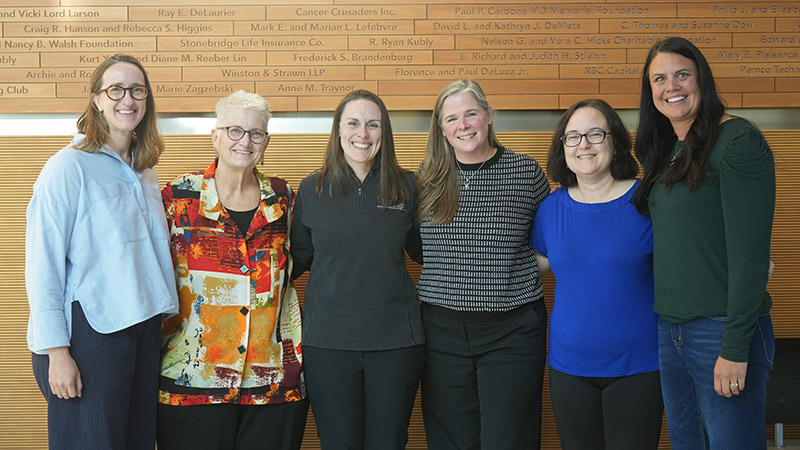
Birkeland, a 2007 graduate of the program, became its director in 2022. A 2012 graduate of the program and assistant professor in the Department of Pediatrics, Ashley Kuhl, MS, CGC, is the assistant program director. April Hall, PhD, MS, CGC, assistant professor in the Department of Pediatrics, is associate director of research. The program’s medical director since 2016 is Elizabeth Petty, MD, professor in the Division of Genetics and Metabolism, and senior associate dean for academic affairs.
In 2025, 283 applicants vied for eight places in the program. The rigorous 41-credit curriculum rests on three pillars: didactics in medical genetics and counseling theory; clinical skills and practicums; and research, which includes a four-credit project. Clinical rotations begin in the first year, guided by more than 50 certified genetic counselor supervisors across six health care systems. Students choose a Madison track, a rural track with Marshfield, or a dual degree with a Master of Public Health (there is one slot for a dual-degree student, which requires a third year). They must pass a two-part comprehensive exam and, within a year of graduating, the national board certification exam.
“It’s a busy 21 months,” Kuhl said.
Birkeland noted that students arrive knowing what they want. “They’re super smart; they can get into graduate school or medical school or whatever school they want, but they’ve figured out they don’t want that,” she said. “Instead, they want genetic counseling.”
That rigor meets real demand. In a 2018 article, then director Reiser cited a projected 28% growth in genetic counselor employment from 2016 to 2026 and a national shortage of genetic counselors in patient care. While that rapid growth has slowed recently, UW–Madison graduates not only secure employment, but they also show remarkable initiative in creating positions. Throughout UW Health and beyond, graduates have worked to establish new clinical genetics services through recognizing unaddressed needs and expanding patient care.
Birkeland also sees a larger role for the program. Just as many fellows in subspecialties add a Master of Public Health during their training (and MGCS offers one student the MPH track), she envisions genetics education becoming an elective addition to Department of Pediatrics fellowships and other specialty training.
“What I would love to see is more people completing their pediatrics or their OB, neurology, cardiology — whatever their subspecialty, and then adding genetics, just as they’d complete an MPH. Because similar to public health issues, genetics is everywhere in medicine,” Birkeland said.
Kuhl noted that the groundwork exists. “Genetic counselors are often the genetics presence within a clinic right now. They bring their genetic expertise to work collaboratively with a team to focus on the patient, family, and community wherever they are working,” Kuhl explained. “Our profession is expanding beyond clinical spaces, with transferable skills that are useful in new places, including public health. An MGCS addition for other subspecialties would be extending those skills into the wider education space.”
Ready on day one
Kaela Kraft graduated from the program in May 2026 and now works in South Carolina as a genetic counselor, dividing her time between oncology and prenatal care. She recently took the board exam.
“A lot of the material that was covered in my board study course was what we discussed in depth within the program,” Kraft said.
She credits the program’s first-year clinical rotations, which is not common among programs, as the reason why her colleagues came to rely on her so quickly. “My coworkers have a lot of trust in me, which is really nice for me as a new graduate going into two specialties,” she said.
Photo by Kate Feldt/Department of Pediatrics