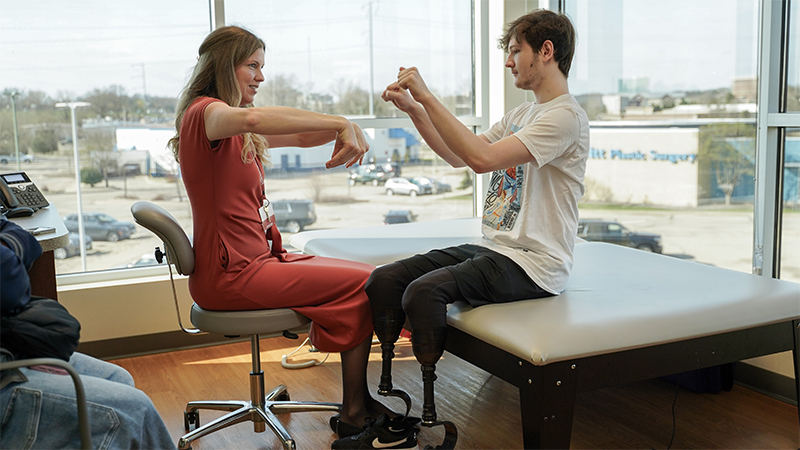
There are a range of upper and lower limb conditions that are addressed by physicians with specialized training and expertise. Deanna Jewell, DO, assistant professor in the Division of Developmental Pediatrics and Rehabilitation Medicine, is one of those physicians. In the summer of 2024, she established two clinics to care for patients with limb differences. The upper limb difference clinic includes Jewell; Brett Michelotti, MD, an associate professor in the Department of Surgery and a plastic surgeon who specializes in hand surgery; and an occupational therapist. The lower limb difference clinic includes Jewell and UW Health prosthetists. These clinics are the only ones of their kind in Wisconsin, and one of a few in the Midwest. They are each scheduled quarterly but are expanding as the need continues to grow.
Jewell joined the faculty in 2021. Her residency training in Physical Medicine and Rehabilitation at the University of Missouri involved inpatient amputee service as well as amputee clinics at the VA Medical Center and university hospital. She went on to complete fellowship training in Pediatric Rehabilitation Medicine at Children’s Mercy Hospital in Kansas City, with robust pediatric limb difference care in the inpatient and outpatient settings.
Jewell treats congenital limb deficiency or acquired amputation from trauma or disease. Children with limb differences face unique medical, developmental, and functional challenges. Those with congenital limb deficiency may have a limb that is smaller, or a portion of the limb could be absent. “Congenital limb difference can be unexpected,” Jewell said. “It is a time for me to connect with the family, to introduce our team, and walk them through the care we can provide for their child.”
The multidisciplinary teams review and address medical concerns for children with congenital limb difference and amputation, with focus on function and quality of life. Treatments aim to support the patient to reach their functional goals over the course of the child’s lifetime. This can include prescription for prosthetics, orthotics, or therapy referrals for targeted goals. Additionally, management includes monitoring skin, managing phantom pain, attention to psychosocial concerns and school integration, preventative musculoskeletal care with a focus on patient education and risk reduction, and potential surgical intervention. “My goal for my patients is to achieve their fullest functional potential,” Jewell explained. “That journey is unique to each child.”
For acquired limb differences, Jewell provides consults in the hospital after an amputation, an often-difficult time for the families. She discusses many things with the family and patient, such as managing pain, preventing swelling and contracture, and other precautions to take to prevent complications after leaving the hospital. She also introduces the family to the limb team and answers questions about the child’s future regarding prosthetics, care of the residual limb, equipment needs, and therapy, as well as a plan for a return to school, sports, and hobbies.
Families often have questions; Jewell and her team address them. “Common questions I hear include: What does return to school look like? When will she be able to play soccer again? What does the future hold?,” Jewell said. Parents are relieved to know that there is a team available to support them and their child.
Jewell has specialized training and knowledge of residual limb biomechanics and the neuromuscular demands of the prosthetic user along with extensive understanding of the complexities of prosthetic prescriptions. She knows how to match the device to a patient’s functional goals and trajectory. Prosthetics is an evolving field with many advances in componentry. Jewell works with prosthetists from UW Health and Hanger Clinic to assess the patient for the appropriate prosthetic prescription.
“There are many intricacies in determining components that a patient may need,” Jewell explained. “Component selection is highly individualized. We evaluate each child’s developmental stage, activity level, and athletic goals to determine the right fit for their specific needs.”
As pediatric patients with limb differences adjust to their lives, Jewell engages in developmental surveillance, monitoring their gross and fine motor skills. She also screens for musculoskeletal imbalances and altered mechanics, with a goal of addressing these concerns to prevent overuse injuries.
Beyond her clinic work, Jewell is involved in an international professional organization that is dedicated to pediatric prosthetic care. She is on the board of the Association of Children’s Prosthetic Orthotic Clinics. “The organization is recognized as a worldwide leader in multidisciplinary rehabilitation care of children with musculoskeletal difference,” Jewell said.
Maria Stanley, MD, professor and chief of the Division of Developmental Pediatrics and Rehabilitation Medicine, explained that previously, children with limb differences did not have a dedicated clinic with specialized expertise in the UW Health system. Families would have to travel, sometimes out of state, to get needed care. Other families who were not able to travel might have a child that went without needed care.
“We are fortunate to have Dr. Jewell as a part of our team,” Stanely said. “She shared her enthusiasm for this patient population from the time she joined us and worked toward building these multidisciplinary clinics in our system. Her involvement with organizations at the national and international level helps to assure that patients are receiving state-of-the-art, remarkable care.”
Jewell’s limb differences clinics are located in the Deming Way Clinic in Middleton. Primary care physicians can put in a referral for their patients to Pediatric Rehabilitation Medicine, with an option to select the limb differences clinic.
Photo by Kate Feldt/Department of Pediatrics