Procedural sedation is essential for safely performing various diagnostic and therapeutic procedures in pediatric patients, where pharmacologic methods are often needed to manage anxiety, pain, and/or movement.
Common Patient Populations
Below are some examples of common patient populations who may require procedural sedation:
- Patients undergoing treatment for leukemia require repeated painful procedures such as bone marrow biopsies and lumbar punctures.
- Patients with common neurological and neuro-oncological conditions require repeated brain imaging that requires a high degree of stillness for prolonged periods of time.
- Neurodivergent patients, including patients with developmental delays or with autism spectrum disorder, may have difficulty cooperating with procedures that require stillness or that cause discomfort, such as EEG lead placement or MRI.
- Patients with significant needle phobia may struggle with procedures such as routine vaccinations, peripheral IV insertion, and phlebotomy.
The Procedure
Defining the characteristics of the procedure assists in determining the most appropriate sedative agent. Based on the degree of procedural pain and amount of procedural immobility (stillness needed to complete the procedure), four categories of procedures can be defined. The box below describes the four categories in terms of desired clinical effects, types of procedures, and appropriate sedative medications.
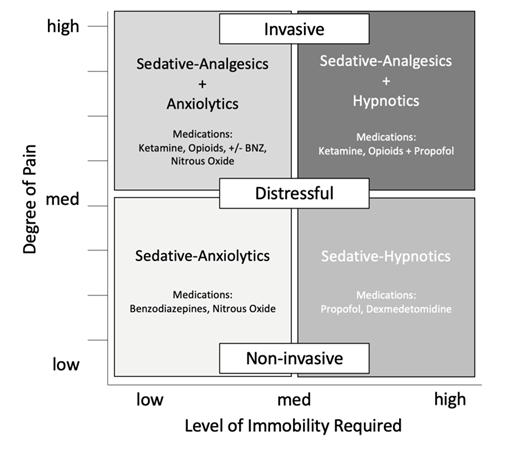
Painful (invasive) procedures
e.g. Heme/Onc procedures: lumbar punctures, bone marrow biopsies
- Invasive procedures are considered one of the most stressful parts of pediatric cancer treatment.
- Initial poorly controlled procedural pain is associated with the development of anxiety related disorders in children and diminished analgesic effects in subsequent procedures.
- The American Academy of Pediatrics (AAP) recommends that procedural pain management be part of the “front line” treatment in children with cancer (Pediatrics 1990; 86:826).
- “Make sure that pain is treated promptly and adequately” is the #1 request from a Parent’s Wish List for interactions with their children’s doctors.
Non-painful (non-invasive) procedures
- Non-invasive diagnostic studies that require a high level of patient “immobility” to be satisfactorily completed and interpretable include ABRs, MRIs, CTs, PETs, and nuclear medicine scans. These studies often require moderate to deep sedation.
- ECHOs and ultrasounds typically require less immobility and consequently a lower level of sedation.
References
Zeltzer LK, Altman A, Cohen D, et al. Report of the subcommittee on the management of pain associated with procedures in children with cancer. Pediatrics1990;826-831.