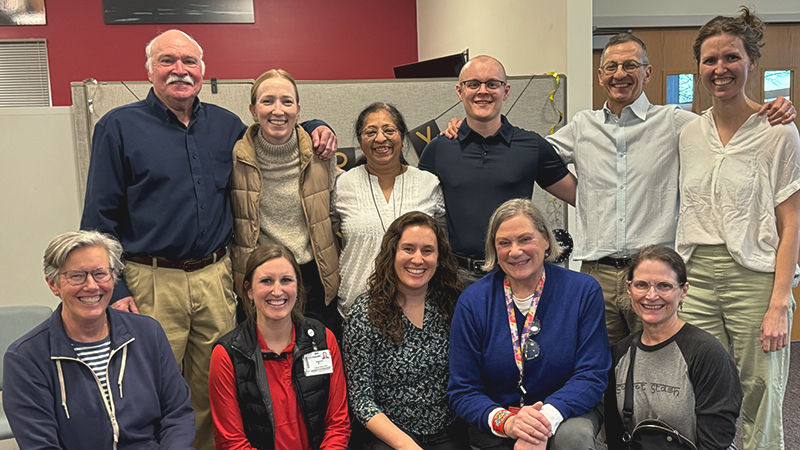
In the photo: Members of the UW Health Kids Fitness Clinic. Back row, left to right, Randy Clark, exercise physiologist; Rachel Fenske, RDN; Yashoda (Mita) Naik, MBBS; Mitchell Hessburg, exercise physiologist; Aaron Carrel, MD; McKenna Jones, RDN. Front row, left to right, Diane Scherschel, exercise physiologist; Stephanie Martin, exercise physiologist and clinic liaison and coordinator; Taylor Ducke, RDN; Ellen Houston, exercise physiologist; and Peg Maher, RDN.
In 1999, when he joined the Department of Pediatrics Division of Endocrinology and Diabetes, Aaron Carrel, MD, now professor, founded the Pediatric Fitness Clinic. He felt strongly that attention to young patients’ diets and introduction to exercise early on could result in health benefits later in their lives, and he wanted to facilitate that in any way he could.

“I started the clinic because a lot of kids were coming to our endocrine clinic to determine if their obesity had some endocrine cause, and most kids with obesity in this country don’t have an underlying endocrine disorder,” Carrel explained. “So we were, essentially, ruling out disorders and then just sending kids back to their pediatricians with nothing. So we started the clinic as a place for kids to come and learn how to exercise, how to move.”
It started as a lifestyle clinic; there were no medications at that time to treat obesity. Children met with a pediatric endocrinologist — just Carrel at first — along with a single pediatric nutritionist and pediatric exercise physiologist. “We all had a commitment to kids with obesity,” Carrel said, “and wanted to help them. And it was very much the practice of pediatrics in that it was preventive care and preventive health for kids.”
And preventive care is essential, as childhood obesity predisposes patients to greater risks for not only diabetes, but also for hypertension, cardiovascular disease, kidney conditions, asthma, and more.
Now, more than 25 years later, the UW Health Kids Fitness Clinic is located in the bright, spacious UW Health Science Drive Medical Center and has expanded to include a large, varied team of health care professionals. Today, the clinic offers the expertise of five physicians, a dedicated clinic coordinator with a background in wellness and exercise physiology, plus an expert cohort of exercise physiologists, pediatric nurses, and registered dietitians. The clinic’s liaison and coordinator, Stephanie Martin, works to set a welcoming and positive tone for patients even before their first visit.
Besides Carrel, there are now two more physicians from the Department of Pediatrics Division of Endocrinology and Diabetes: Jennifer Rehm, MD, associate professor, and Yashoda (Mita) Naik, MBBS, assistant professor. A fourth member from the division who will join this summer as an assistant professor is Kimberly Vidmar, MD. In addition, Magnolia Larson, DO, associate professor, is in the Department of Family Medicine and Community Health.
“Our long-time exercise physiologist and health and wellness coach, Ellen Houston, is about to retire,” Carrel noted with obvious regret. “She has been here since 2012, and before that with the Madison Metropolitan School District — 25 years of this close work with kids. It’s her superpower to get kids to open up and start to consider ways they can help their bodies move and stay healthy. She can get kids walking on a treadmill facing the wall of windows, and they’ll start talking, opening up. What do they want out of this? How does it differ from what their parents want? That ability to connect with kids is so valuable, and we will miss her.”
A new exercise physiologist will start soon after Houston steps away from the clinic.
During their first hour-long appointment, patients receive an evaluative exam, a body composition scan, an exercise evaluation to determine levels of fitness and set goals, plus a nutrition consultation to establish healthy eating goals. The team uses a positive approach to body image and motivational interviewing techniques. Follow-up appointments are coordinated with the care team.
Clinic patients are also invited to join Get Fit, a monitored exercise therapy program that is held in the clinic’s exercise science lab every week. Get Fit’s goal is to help patients take their individual exercise plan and put it into action. (Learn more from the UW Health clinic web pages for information about the staff and the clinic’s services.)
Most notably, in the two decades since the clinic’s beginning, the science of obesity, both in adults and children, has advanced considerably. Recently, new weight loss medications have been approved for adults and children, not only for weight loss, but also to mitigate the development of type 2 diabetes.

The newest member of the team, Dr. Mita Naik, is board certified in obesity medicine and was recruited in 2024 to help the clinic expand in this area. Her primary clinical and academic focus is weight management and the health effects of pediatric obesity.
“We recognize that body size is influenced by genetics and family patterns. We encourage children and families to approach their health without guilt or blame. Our clinic takes a positive, strength-based approach to fitness and weight management,” Naik explained. “Lifestyle intervention is the foundation of care.”
Early humans lived by seeking food every day. From an evolutionary perspective, the human body adapted to conserve energy to survive periods of food scarcity. That is one of the reasons losing weight and keeping it off is so difficult — the body does not easily give up its saved stores of energy.
“This makes maintenance more challenging than initial weight loss for most people,” Naik said, “reinforcing the need for long-term strategies and support.”
Regain of weight is also one of the downsides of the new weight-loss drugs. Glucagon-like peptide-1 (GLP-1) is a gut hormone that regulates blood sugar and appetite. The new receptor agonist drugs (such as semaglutide and tirzepatide) mimic the natural hormone. They are intended to treat type 2 diabetes and obesity by increasing insulin, slowing digestion, and creating a feeling of satiety.
The first drug of this kind, liraglutide, was approved by the Food and Drug Administration (FDA) in 2014 for weight loss; it was previously available for diabetes. In 2020, the FDA approved this drug for children aged 12 and older with obesity. Semaglutide received the same approval in 2022. Anti-obesity medications were added to the American Academy of Pediatrics (AAP) guidelines in 2023. (This Centers for Disease Control and Prevention report is instructive.)
The GLP-1 drugs do facilitate weight loss, but there are unpleasant side effects (nausea, digestive issues). And when patients stop taking the drug, weight will likely return. Naik prescribes these drugs sparingly, primarily for those who have tried lifestyle intervention and remain at a high risk of developing type 2 diabetes, cholesterol disorder, sleep apnea, and other conditions.
“Dr. Naik adds a whole new tool set to our toolbox,” Carrel said. “We see kids not just with obesity, but also with cholesterol disorders, pre-diabetes, and other markers that make us worry about their risk of developing full diabetes. It’s nice to have this multidisciplinary comprehensive clinic, with many expert voices that can help kids listen and understand the different angles of nutrition and exercise.”
While Carrel and his team are deeply committed to helping all kids with obesity, garnering sufficient staff and resources to care for all who need their services remains a challenge. Now, they see 12 new patients and 26 returning patients every week (about 600 new patients per year), and are working on increasing their availability for their waitlist. They are also strategizing new ways for kids to engage in healthy exercise with groups outside of UW Health. It is a work in progress.