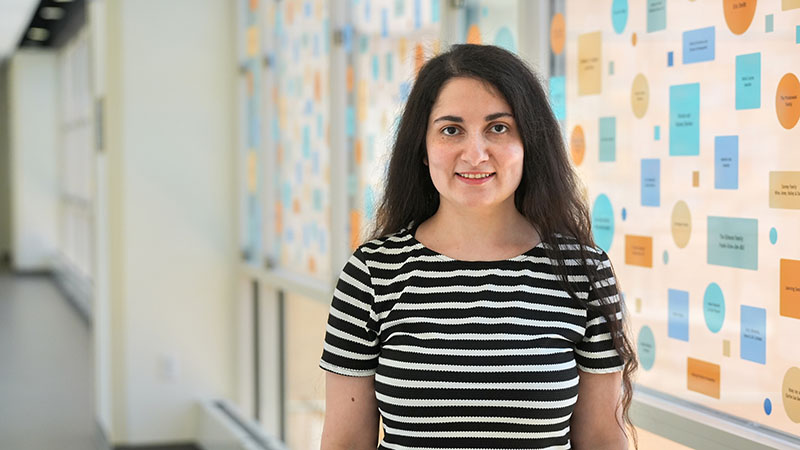
Narmin Javadova, MD, PGY-5 fellow in the Division of Neonatology and Newborn Nursery and a graduate of the University of Wisconsin Pediatrics Residency Program, has been selected for the Pediatric Scientist Development Program (PSDP). The PSDP is an NIH K12 training award funded through the Eunice Kennedy Shriver National Institute of Child Health and Human Development and administered by the Association of Medical School Pediatric Department Chairs. It provides two to three years of protected research time at 80% or greater effort, together with research support, structured mentorship, and integration into a national network of pediatrician-scientists — support that extends well beyond the funding itself. Javadova begins her three-year PSDP fellowship on July 1, 2027.
Javadova was inspired to pursue research early in her medical training. She saw up close how much of today’s care exists because of past discoveries, especially in neonatology, where research has helped babies born extremely early survive and thrive.
“Caring for patients is deeply meaningful, but I wanted to help answer the questions that improve care for many more children and families, and that led me to research,” she said. “This award gives me the protected time, mentorship, and national community I need to grow into an independent physician-scientist.”
Javadova’s research addresses a gap that has long constrained newborn care: neurodevelopmental impairments affect approximately one in six children in the U.S., yet no accessible, noninvasive measure exists to identify which infants are at highest risk during the first two years of life — the period when brain plasticity is greatest and intervention most effective. Biomarkers measurable at birth could close that gap. Based in the Developing Brain Imaging Lab at the Waisman Center, Javadova is developing such a framework using a prospectively collected, deeply phenotyped group of term infant–maternal dyads with cord blood obtained at delivery, diffusion MRI at one month of age, and developmental assessments through 24 months.
The project integrates four biological layers that have not previously been examined together:
- A panel of cord blood inflammatory and iron regulatory biomarkers.
- The protein cargo of brain-derived extracellular vesicles (BDEVs) — nanoscale particles released by neural cells that cross the blood-brain barrier and carry proteins reflecting conditions within the developing brain itself.
- Genome-wide DNA methylation, which Javadova will use to test whether prenatal inflammatory and iron regulatory exposures leave a lasting epigenetic imprint.
- Neonatal brain microstructure, characterized with advanced diffusion MRI methods that extend beyond conventional imaging to resolve neurite density and fiber organization in both white and gray matter.
Across three specific aims, Javadova will relate maternal health conditions to these molecular signatures, determine whether the signatures correspond to measurable differences in brain microstructure, and test whether they predict socioemotional and executive function outcomes at 24 months — with brain microstructure examined as the pathway linking early biology to later behavior.
“I hope this research will help us identify babies at risk for developmental difficulties around birth, so we can offer support sooner, when the brain is most adaptable,” she said, “My goal is for NICU graduates and other at-risk children, in Wisconsin and beyond, to thrive.”
Douglas Dean III, PhD, associate professor in the Division of Neonatology and Newborn Nursery and director of the Developing Brain Imaging Lab, will serve as Javadova’s primary research mentor. Ryan McAdams, MD, professor, Divisions of Neonatology and Newborn Nursery and Global Pediatrics, will serve as her co-mentor and contribute expertise in clinical neonatology, translational study design, and machine learning-based predictive modeling. Phu Tran, PhD, and Michael K. Georgieff, MD, both of the University of Minnesota, will serve as collaborators. Pamela Kling, MD, professor emerita, Department of Pediatrics, and Christopher Coe, PhD, professor emeritus, Department of Psychology, will serve as advisory mentors.
Javadova is the second-ever fellow from the Department of Pediatrics at the UW School of Medicine and Public Health chosen for this training program.
Photo by Department of Pediatrics/Kate Feldt