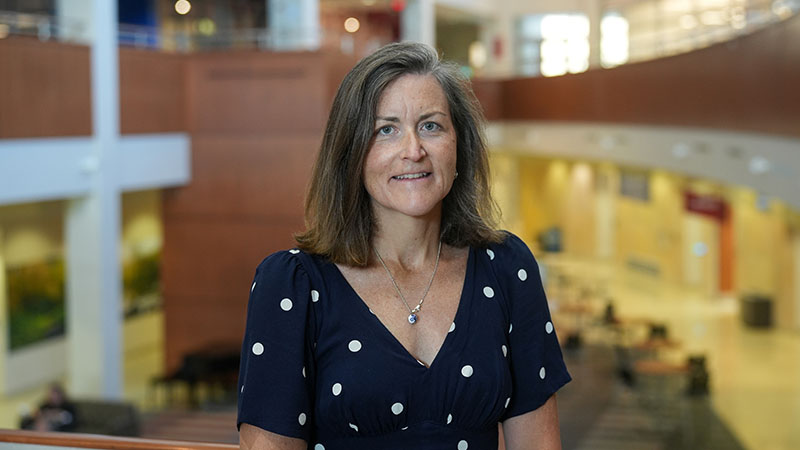
On August 15, the University of Wisconsin School of Medicine and Public Health Department of Pediatrics welcomed a new faculty member who will serve as chief of the Division of Nephrology. Margret Bock, MD, MS, visiting professor, brings exemplary clinical and academic expertise as well as extensive research in critical areas of pediatric solid organ transplantation.
Bock comes to us from the University of Colorado School of Medicine, where she was associate professor of pediatrics and medical director of pediatric kidney transplantation at Children’s Hospital Colorado. She earned her MD from Harvard Medical School and completed residency, pediatric nephrology fellowship, and transplant nephrology fellowship at Northwestern University Feinberg School of Medicine/Children’s Memorial Hospital (now Lurie Children’s) in Chicago. During her nephrology fellowship years, she also completed a master of science in clinical investigation at Northwestern University.
The central theme of Bock’s research is the development, implementation, and evaluation of structured transition programs for adolescents and young adults after solid organ transplantation. The periods of adolescence and young adulthood are times of heightened vulnerability for transplant patients, with increased risks of nonadherence, graft dysfunction, and loss to follow-up and health care disengagement. Her research seeks to identify modifiable risk factors during this transition and to design interventions that promote continuity of care, self-management skills, and long-term graft and patient survival. Bock’s research vision for the future is to position adolescent and young adult transition of care as a core driver of long-term outcomes for children after solid organ transplantation.
Bock noted that members of health care teams have very definite goals for the young people who transition from pediatric to adult care. It’s essential to realize that those patients’ immediate goals may be completely different from the team’s immediate goals.
“Whether one is a physician, a nurse, a dietician, a psychologist, we all have these frameworks from adulthood that we think we should be putting on them,” she explained, “but the more we do this, the more I believe the patient-directed approach to self-transition is where the research points, ideally led by kids or young adults who just went through the transition. They can tell us how better to do this. We may be structural support versus the engine that’s driving this.”
The author of more than 80 peer‑reviewed publications, abstracts, and book chapters, Bock has also served as site principal investigator or co‑investigator on numerous multicenter NIH, DoD, and industry‑sponsored studies. In her previous role as medical director of pediatric kidney transplantation at Children’s Hospital Colorado, she provided leadership and oversight to a large, multidisciplinary team at an academic quaternary regional referral center.
With extensive experience in education and mentorship as well, Bock has led innovative curriculum development, taught medical students and residents, and mentored a generation of pediatric nephrology fellows and junior faculty — many of whom now lead programs around the country.
Get to know Bock: read her online profile and the Q&A below.
Your hometown?
Vienna, Austria
Your previous position?
Medical director of kidney transplantation at Children’s Hospital Colorado and associate professor of pediatrics (nephrology) at University of Colorado School of Medicine
Why did you choose the field of pediatrics?
I liked the idea of being able to care for a wide range of physiology and pathophysiology encompassing the neonatal period, through childhood and into adolescence and young adulthood.
What attracted you to UW–Madison?
- Academic excellence
- Opportunities for growth
- Amazing people — wonderful faculty and staff!
- Inclusive, kind, and inviting community
What are you most excited to start working on as chief of the Division of Nephrology?
I am most excited to join an outstanding group of faculty and staff and continue the work to build on existing momentum within the division to develop and support ongoing and new efforts related to academic, clinical, and service growth.
Do you have ongoing research? If so, how will you continue your efforts?
The majority of my research efforts are centered around outcomes in children and adolescents who are listed for or have received solid organ transplants. I am specifically interested in a patient-centered approach to transitioning from pediatric to adult care and how this might impact longitudinal patient/allograft survival and satisfaction with care models.
How do you think the role of division chief will influence your goals as a physician?
The whole is greater than the sum of its parts — I view my role as a division chief to lead by fostering an environment where faculty and staff feel supported, valued, and empowered to do their best work. I hope to help colleagues navigate challenges, develop professionally, and pursue their individual strengths and interests while promoting collaboration and a shared sense of purpose.
What’s something interesting about your areas of expertise you can share that will make us sound smarter during video chats and parties?
The first artificial kidney was developed in the Netherlands during WW2 — and it used sausage casings to act as a permeable membrane.
What is the last book you read?
Lázár by Nelio Biedermann
What is your favorite food?
Sushi
Do you have a secret talent?
Knitting (but I am not sure if it is a secret…)
What are some of your hobbies and other interests?
Squash (the racquet sport), hiking, skiing, swimming, knitting and reading fiction
Photo by Kate Feldt/Department of Pediatrics