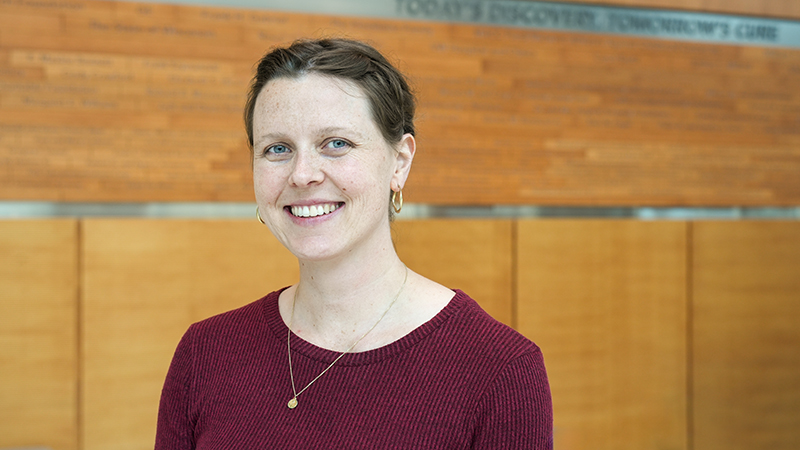
In a historic first for the department, Therese (Tess) Woodring, MD, was selected for the Pediatric Scientist Development Program (PSDP). She is the first-ever fellow from the Department of Pediatrics at the UW School of Medicine and Public Health chosen for this prestigious national program.
Partially funded through the National Institute of Child Health and Human Development (NICHD), the Pediatric Scientist Development Program began in 1986 to promote and support early pediatricians with an MD, DO, or MD/PhD who are committed to a career in scientific research — academic medicine. The program provides two to three years of training for trainees with mentors in established laboratories all over the country where they are afforded substantial support and protected laboratory time.
The program was initiated through the Association of Medical School Pediatric Department Chairs (AMSPDC). Departments of Pediatrics across the country and Canada may submit two nominations each year for the two- to three-year fellowship. Woodring was one of just 11 fellows selected nationally this year. A PGY-6 fellow in the Division of Hematology, Oncology, Transplant, and Cellular Therapy, Woodring is also a graduate of the University of Wisconsin Pediatrics Residency Program and has worked on CAR T cell development with the Richards Research Group (Hematologic Malignancies and Immunotherapy Research Group). Her two-year award began in July 2025.
Woodring’s ongoing work focuses on inborn errors of immunity (IEI), which are caused by variants in genes that impair normal immune function. IEI can manifest in many ways, such as increased susceptibility to infection, autoimmunity, autoinflammation, allergic inflammation, bone marrow failure, and malignancies.
There are now 508 known genes that cause human disease by disrupting immune processes. IEIs manifest in diverse ways, so diagnosis may be delayed or compromised. Early discovery and diagnosis are key.
One life-threatening example is hemophagocytic lymphohistiocytosis (HLH), in which the overactivation of the immune system causes acute inflammation that can lead to organ failure and death. Woodring recently received funding to attend the 2025 Clinical Immunology Society Summer School. There, she presented an atypical case of primary HLH that was diagnosed and successfully treated with bone marrow transplant. The patient was one among many whose initial symptoms and definitive therapy brought them to the University of Wisconsin.
“Because inborn errors of immunity (IEI) can be associated with blood count abnormalities and cancer, we end up seeing these patients in Pediatric Hematology/Oncology,” Woodring said. “For some of these patients, bone marrow transplant may be a life-saving intervention. Our treatment decisions depend on understanding the underlying molecular defect for each patient. With my research, I hope to improve our ability to diagnose known and novel IEI in a timely manner.”
Woodring will be further investigating IEI during her PSDP time. She will be working with two mentors from the UW School of Medicine and Public Health: Christine Seroogy, MD, professor in the Division of Allergy, Immunology, and Rheumatology, who oversees the Primary Immunodeficiency Clinic at American Family Children’s Hospital; and Jane Churpek, MD, MS, associate professor and adult hematologist/oncologist in the Department of Medicine. Churpek runs a lab in which she and her team investigate how the genetics a person is born with or acquires can set one up for blood disorders or cancer.
In addition, the PSDP program specifies one mentor from outside a fellow’s institution to complement the local mentors. Woodring will also be guided by Joseph W. St. Geme III, MD, professor of pediatrics and microbiology at the Perelman School of Medicine at the University of Pennsylvania. He is the physician-in-chief of the Children’s Hospital of Philadelphia and also an active researcher, focusing on host-pathogen interactions involving pathogenic bacteria.
Seroogy pointed out the clear focus of the Pediatric Scientist Development Program. “The most important thing about the [PSDP] program is that it recognizes and supports the development of physicians who are interested in improving the lives of children,” Seroogy said. “This is an exciting time because our scientific tools continue to improve — and Tess will tap into that. I’m confident that she will make discoveries that will eventually lead to improving the care of children with inborn errors of immunity.”
“The research I am interested in is very translational,” Woodring explained. “What you experience as a child’s doctor at the bedside helps you ask the relevant scientific questions at the bench. We also depend so much on our partnerships with patients and their families. Without their support, we would not have the clinical stories and samples needed to advance our understanding of these rare diseases and help the next patients.”
Woodring would like to build an IEI research program at the University of Wisconsin. “New IEIs are discovered every year,” Woodring said. “At the University of Wisconsin, we have the potential to contribute to this growing field and manage the transplant care that these patients may need.”
John Williams, MD, professor and chair of the Department of Pediatrics (and member of AMSPDC), served as a mentor of PSDP fellows when he was the chief of the Division of Pediatric Infectious Diseases at the University of Pittsburgh School of Medicine. He noted why the PSDP is an important program and how it supports its fellows.
“The highly competitive PSDP offers three years of funding support for the fellow plus research supplies, matches them with a pediatric physician-scientist mentor at another institution, and connects them to the national network of pediatric physician-scientists,” Williams explained. “Thus, it’s not just the funding — it’s truly career support and network building.”
Photo by Kate Feldt/Department of Pediatrics