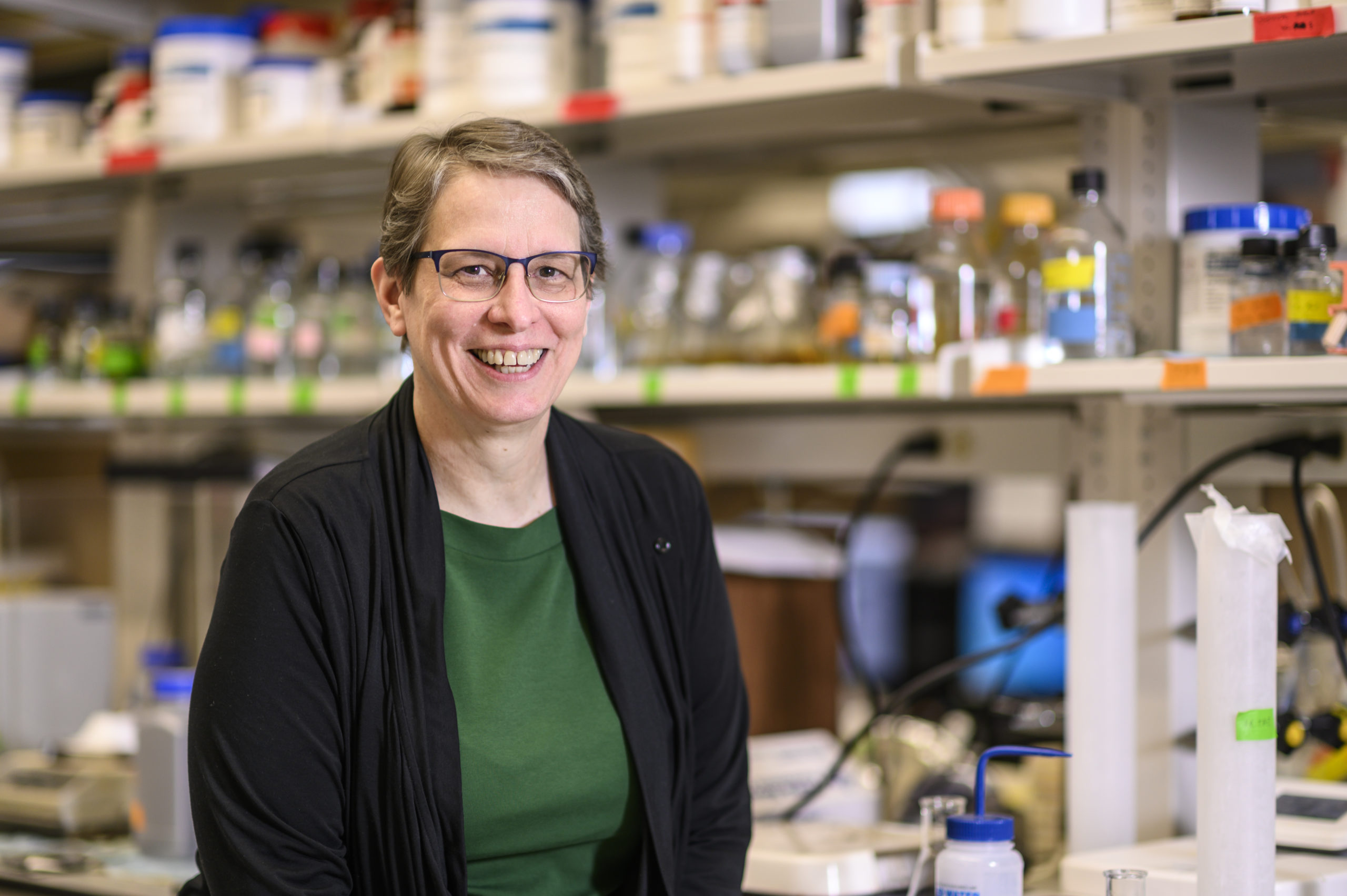
After more than 26 years of astoundingly productive work as a research scientist investigating human eye (and surprisingly related kidney) conditions, Christine Sorenson, PhD, distinguished scientist III in the Division of Neonatology and Newborn Nursery, will retire on August 24.
Sorenson’s research goal has been to better address ocular diseases with pathologic neovascularization in order to define possible treatments and determine which patients will have the most effective response to those treatments. Her eye research also relates to kidneys because the retina and the kidney share many developmental and disease-related abnormalities arising from neovascularization and the control of apoptosis — the cell’s own programmed cell death to recycle out old, damaged, or unneeded cells. Alterations in cell functions may lead to abnormal retinal and kidney development and disease states. Her research has also addressed wet age-related macular degeneration, which also arises through disrupted apoptosis.
The Sorenson Research Group’s discoveries from this research provide insights into fundamental biology and lay the groundwork for improved treatments for blindness. Sorenson is also a member of the McPherson Eye Research Institute, where she bridges pediatrics, ophthalmology, and neuroscience. Mentoring the next generation of researchers has always been an area that encourages and inspires her to connect and transfer her knowledge and drive to those just entering science as a life choice.
With 140 peer-reviewed publications, an h-index above 50, and over 11,000 citations, Sorenson has established herself and the UW as leaders in ocular vascular biology.
“From my perspective, Sorenson is the kind of colleague who makes others better. She asks sharp scientific questions, approaches challenges with persistence, and collaborates with openness and respect,” wrote Ryan McAdams, MD, professor, Divisions of Neonatology and Newborn Nursery and Global Pediatrics, in Sorenson’s nomination for last year’s Dean’s Research Staff Awards. Sorenson was one of four inaugural winners for this new award last November. Sorenson also won the Chancellor’s Award for Excellence in Research, Independent Investigator Category, in 2022.
Five questions for Christine Sorenson:
How has your career surprised you, compared to how you had expected it to develop when you began?
The biggest surprise has been my transition into in vivo and ex vivo research. Early in my career, I never imagined I would work with animal models because I was actually afraid of animals. Over time, however, I recognized how essential these models are for understanding disease mechanisms and developing new therapies. Embracing this challenge opened an entirely new and rewarding direction for my research.
What do you consider to be your biggest achievement?
My greatest achievement has been mentoring undergraduate students, graduate students, and postdoctoral fellows. There is nothing more rewarding than seeing a difficult concept suddenly “click” and watching their excitement as they gain confidence in their work. It has been especially gratifying to see so many of them go on to successful careers in science and medicine, and even more meaningful when they still remember and appreciate the time they spent in our laboratory.
What have been the most challenging obstacles to overcome?
One of my greatest challenges was establishing a research laboratory as a non-tenure-track faculty member. When I moved into the old H4 module, the area was nearly empty and had very little shared equipment. The only microscope available dated back to the 1960s, and every time I turned it on, I could smell smoke. I had no startup funds, no access to computer support, no access to many campus core resources, and even had to establish a separate purchase order for every company we ordered supplies from. I also had just had our daughter before the move here. Looking back, I’m amazed I was able to publish anything during those first few years. Those experiences taught me resourcefulness, persistence, and the importance of making the most of limited resources.
What advice would you offer to new physicians and scientists just starting out?
Be persistent, stay curious, and never stop asking questions. Research rarely follows a straight path, and setbacks are inevitable. The key is to remain focused, keep learning, and continue moving forward.
Do you have specific plans for your retirement you’d like to share?
I’m looking forward to sleeping past 5:30 a.m. and spending more time traveling with my family. After many years of balancing research, teaching, and administrative responsibilities, I’m excited to enjoy a slower pace while exploring new places and making lasting memories with those closest to me.
Please let us know about any people you’d like to thank.
I would like to thank everyone in the Division of Neonatology and Newborn Nursery, especially the division chiefs, for their friendship, encouragement, and support throughout my career. They always made me feel like part of the team by including me in journal clubs and division activities, and I am truly grateful for their collegiality and kindness over the years.
Photo by Althea Dotzour/UW–Madison