Antibiotics are the medications most commonly prescribed to children and among medicine’s most powerful tools. But every dose that’s incorrectly prescribed can give bacteria a chance to adapt and allow resistant organisms to spread from patient to patient. The Centers for Disease Control and Prevention (CDC) estimates that more than 2.8 million antibiotic-resistant infections occur in the United States each year, and more than 35,000 people die as a result. The CDC also estimates that about 30% of antibiotics prescribed in U.S. hospitals are unnecessary or suboptimal.
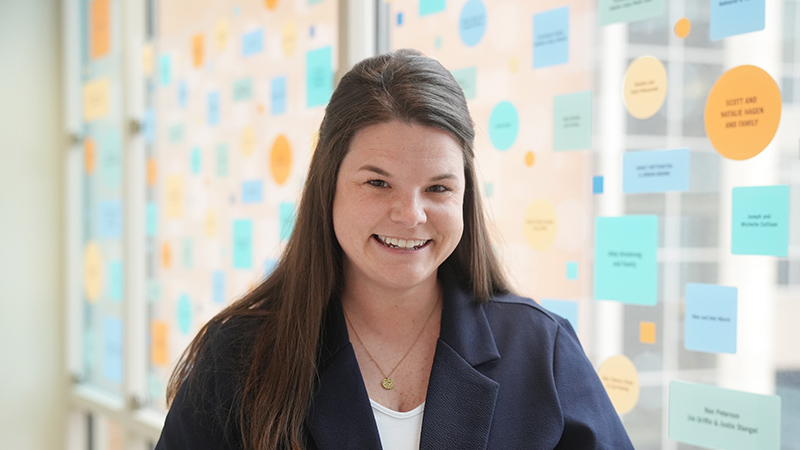
Antimicrobial stewardship (AMS) is the discipline devoted to closing the gap between appropriate and inappropriate antibiotic use. At American Family Children’s Hospital (AFCH), this effort is led by Brittany Lehrer, MD, MPH, assistant professor in the Division of Infectious Diseases and the director of the pediatric antimicrobial stewardship program. Lehrer was recruited in late 2024 to succeed the previous director of the program, Sheryl Henderson, MD, PhD, who retired in June of that year.
UW Health’s antimicrobial stewardship program was first initiated in 2002 and is now recognized as an established leader in the field. UW Health is one of a few academic centers in the nation to be recognized by the Infectious Diseases Society of America as a Center of Excellence for Antimicrobial Stewardship. It’s also recognized for achievement of the seven core elements of hospital stewardship: Leadership Commitment, Accountability, Drug Expertise, Action, Tracking, Reporting, and Education.
Lehrer calls the timing that brought her to the Department of Pediatrics and AFCH’s antimicrobial stewardship program serendipitous because it allowed her to find her dream job in her home state of Wisconsin. She earned her undergraduate degree at UW–La Crosse and her medical degree at Chicago Medical School at Rosalind Franklin University of Medicine and Science. Her training in pediatrics was at the Medical College of Wisconsin, and she completed fellowships in pediatric infectious diseases and clinical pharmacology, as well as a Master of Public Health degree, at Vanderbilt University in Nashville, Tennessee. Lehrer decided to become a physician in part because of her childhood experience watching doctors care for two of her sisters who had serious medical conditions. And the subspeciality of infectious diseases drew her through the enormous variety of conditions it addresses.
“In the infectious diseases subspecialty you get to see the coolest cases,” she said. “You can be in any part of the hospital — the specialty isn’t limited to a single unit or a particular body system. And for most infections, you can actually cure the patients, not just treat them. That’s amazing to me.”
During her training, she was able to see resistance patterns growing on urine cultures — the sign in a laboratory of an antibiotic losing its power to resistant bacteria. Her strong mentors helped guide her to antimicrobial stewardship.
Stewardship, as Lehrer defines it, means not using antibiotics for viral infections, which they cannot treat, while making sure that when an antibiotic is needed, the patient receives the right drug at the right dose, the right frequency, and right duration. Sometimes that can mean broadening antibiotic therapy, because the goal is the right treatment, not simply less of it.
Why knowing better isn’t enough
Prescribing decisions, Lehrer explained, are rarely made on purely clinical grounds. For example, there are operational pressures such as time constraints of an outpatient visit or parental satisfaction surveys for clinicians. Decisions may also be influenced by diagnostic uncertainty with limited ability for patient follow-up or cultural considerations related to returning to school or childcare after being on antibiotics for 12–24 hours. Unintentionally, these factors can have an influence on appropriate antibiotic prescribing.
“I can’t change the culture around prescribing just by providing education; education alone won’t do it,” Lehrer said. “It’s been shown that we have to change behaviors, which is much more difficult. But when we get it done correctly, it’s really satisfying.”
Her research asks why clinicians who know the guidelines still prescribe inappropriately, and how family expectations shape those decisions. For high-pressure moments, her team coaches a four-step conversation: state the exam findings aloud, name the diagnosis, pair what won’t help (“antibiotics won’t fix this”) with what will, and close with a plan if the child doesn’t improve.
When prescribing drifts back to old habits, Lehrer looks first for a practical cause, such as a changed order set or a new group of residents. She also watches the organisms themselves.
“You have to throw in the extra variable of the germs themselves, which are becoming more resistant,” she said. “If our broad-spectrum antibiotic use increased, was it because the germs dictated that, which would be appropriate? Or was it because we were a little nervous, and we used it when we didn’t need to?”
Teaching in small doses
Each weekday, Lehrer’s antimicrobial stewardship team of three health providers reviews all pediatric patients on antimicrobials at AFCH for safety and appropriateness. They also intermittently join divisional meetings across AFCH, holding up what she calls a mirror: here is what we prescribe, here is where we are doing well, here is where we can improve. One example of a successful change inspired by these meetings is related to the surgical teams. Over the past 18 months, Lehrer led a quality improvement project to improve the appropriateness of surgical antibiotic prophylaxis; the project raised appropriate use at AFCH from 61.2% to 86.6%. This improvement could lead to fewer surgical site infections and antibiotic-associated infections — a change that directly benefits patients and the hospital by reducing length of stay, readmission rates, and costs.
For educating residents, Lehrer favors pairing learning with memorable hooks. Her three-hour “Bugs & Drugs” session ends with an escape-room-style challenge in which residents must stop a fictional germ from taking over AFCH by choosing the correct antibiotic, dose, frequency, and duration. She also utilizes five-minute “Bug Busters” trivia questions at Morning Report, which presents a clinical scenario and asks Which antibiotic? And why?
Above all, Lehrer wants colleagues to know that stewardship is a resource, not a police force. Because antibiotic decisions are often more emotional than logical, stewardship can sometimes seem fraught. So, her door is always open: if clinicians disagree with a recommendation, she wants to talk it through. If they have a scientifically sound idea for a stewardship project, she wants to help launch it. Communication and education are everything in a field that is always facing change.
The acute importance of the antimicrobial stewardship program for resident training is clear to Dan Sklansky, MD, professor in the Division of Hospital Medicine and Complex Care and residency program director:
“Dr. Lehrer is a key educator in our department, embodying the true nature of a ‘steward’ in her antimicrobial stewardship role. She is approachable, thoughtful, enthusiastic, and thorough in her explanations to the many lifelong learners she teaches, ranging from phase 2 medical students to seasoned faculty. That said, her work in residency education is particularly effective. Dr. Lehrer has a natural knack for connecting with residents, walking them through patient history, medical knowledge, and clinical synthesis, guiding them to recognize necessary conclusions for patient care. She is just as competent in leading group teaching sessions, employing a dynamic mix of didactics, interactive questions, and hands-on learning stations. We are very fortunate to have her enmeshed into our teaching as the leader of our stewardship education for residents and all learners in our system.”
Photo by Kate Feldt/Department of Pediatrics