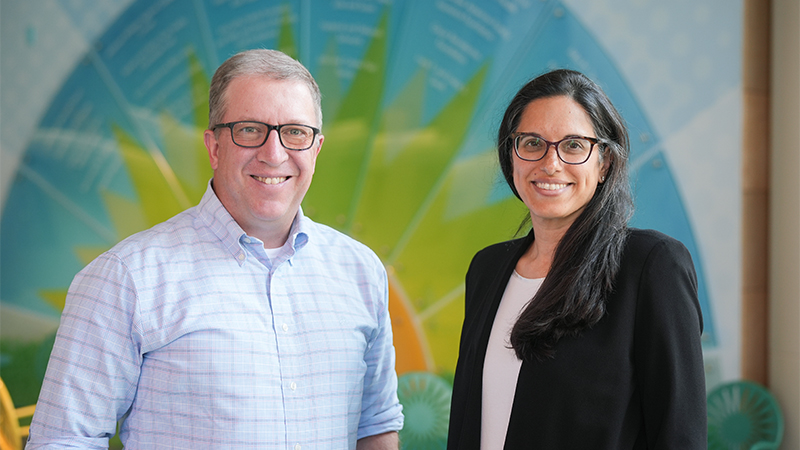
Every standard solution or medication delivered through a line, every alarm sounding in the night, every hand that touches a patient — in a pediatric hospital, the margin for error is vanishingly small. Two Department of Pediatrics faculty members, Nina Menda, MD, MHQS, and Michael Wilhelm, MD, have built careers around the disciplined, data-driven work of making that narrow margin visible and manageable. Menda, as UW Health Kids medical director of quality and patient safety, and Wilhelm, as director of quality and safety for the pediatric intensive care unit (PICU), operate at different levels within the institution, but their aims converge.
A commitment shaped by NICU QI
Nina Menda, MD, MHQS, is associate professor in the Division of Neonatology and Newborn Nursery and, since January 2024, medical director of quality and patient safety for UW Health Kids. She came to quality improvement the way many do: through a moment of clarity mid-training.
As a neonatology fellow, Menda was approached by a pharmacist working on a quality project to reduce dangerous drops in blood sugar in neonatal intensive care unit (NICU) patients. The project ran through a series of small, rapid tests of change over six to nine months, and the harmful episodes were eliminated.
“I could see the impact of our work almost instantaneously, and it was also that collaborative nature. I had to partner with my pharmacist, with my nurses, with the biomed people on the pumps, and figure out how to make this all work in a way that benefited our patients,” Menda said. “I loved that about quality and safety and continued to.”
That early experience shaped her career. Menda holds a master’s degree in health care quality and patient safety from Northwestern University, received a Patient Safety Leadership Award in 2024, and has led quality improvement work at both the NICU and UW Health Kids institutional levels. Her statewide reach includes serving as co-chair of the Wisconsin Perinatal Quality Collaborative (WisPQC), which works to improve outcomes for newborns across the state.
The field of neonatology has been a leader in quality improvement within medicine, Menda noted, in large part because of the Vermont Oxford Network, a national consortium founded in the 1980s to benchmark outcomes for premature newborns and use QI methodology to improve them. UW Health Kids participates actively in both that network and in the Children’s Hospital Neonatal Consortium, which benchmarks care at the highest-level NICUs in the country. This gives the UW’s neonatology team visibility into its own performance at both the state and national levels.
One dimension of NICU quality work that distinguishes it from other specialties is the role of families. NICU patients are nonverbal, entirely dependent, and still developing — which makes family observations both uniquely valuable and deeply integrated into safety efforts.
“Every single quality outcome, every single safety improvement has an impact on a patient in front of us,” Menda said. “To have the voice of that patient is so critical to the work that we do. In neonatology, we’ve really done an excellent job of creating that partnership amongst our multidisciplinary teams in order to really elevate our quality and safety work to the next level.”
That partnership has produced concrete results. A family recently prompted the team to investigate alarm volumes on feeding pumps. They asked whether the alarms needed to be as loud as they were. Staff began collecting data and are now implementing changes based on what they found: decreasing volumes where possible, while educating parents on how to encourage positive sound, including using their own voices near their infants.
The PICU: Building safety into the system
Michael Wilhelm, MD, professor, Division of Critical Care, came to quality improvement by a different route — through basic science research that, over time, could not be sustained. When the last of a series of his research mentors left the university, Wilhelm pivoted fully to clinical and quality work, at a moment when the pediatric heart program at American Family Children’s Hospital was being built and needed his expertise in cardiac critical care.
“Leaving research was difficult, but at the same time, I feel like I’m really doing what I was meant to do right now,” Wilhelm said. “The quality work is so much more natural; it’s such a perfect fit for me that I realize it was a blessing in disguise.”
Since becoming director of quality and safety for the PICU in 2022, Wilhelm has formalized a team-based approach to improvement that he had begun building years earlier. A quality improvement steering committee — comprising physicians, nursing leadership, respiratory therapists, pharmacists, social workers, and nursing care team leaders — meets annually to analyze the year’s data, identify vulnerabilities, and set priorities for the next 12 months.
The PICU at American Family Children’s Hospital handles approximately 1,200 admissions per year, with an average daily census of around 22 patients. By risk-adjusted measures, it cares for some of the sickest pediatric patients in the country, yet its outcomes consistently meet or exceed expectations.
One frontier Wilhelm described concerns what quality improvement has not yet figured out: how to account for the environment itself. Checklists, standard practices, and audit processes have driven enormous gains, but they can only go so far when patient complexity and institutional conditions keep shifting.
“Quality is inherently dependent on the environment,” Wilhelm said. “We can’t just rely on the information that’s currently in the patient’s health records. We also need to feed in information about how busy the hospital is, what the composition of our staffing was, what else is going on. All of these environmental things have to be added to the equation so that the machine learning can be applied to the correct data set, not just to a sterile electronic medical record data set that’s not context-specific.”
To pursue that ambition, Wilhelm is partnering with Neil Munjal, MD, assistant professor, Division of Critical Care, who brings expertise in data science, to build a comprehensive PICU data infrastructure designed from the outset to support both quality improvement and research.
Safety as a shared horizon
Both Menda and Wilhelm described quality improvement as something the field is still learning to do; it’s not a single problem to solve, but an ongoing science with its own methods, its own hypotheses, and its own measures of progress. That science is the bridge between what research shows is possible and what actually happens for a patient in the bed.
The UW Health Kids Quality and Safety Poster Fair, scheduled for September 10 during the Department of Pediatrics Clinical Care Week (September 8–10), will showcase work being done across the institution on exactly these questions. Faculty, fellows, and staff from across UW Health Kids will present projects ranging from patient flow and safe staffing to outcome metrics and family-centered care.
For Menda and Wilhelm, the event represents something much larger than a poster session. It’s robust evidence that safety is not a background process but instead a continuous, collective endeavor, running alongside every clinical encounter.
Photo by Kate Feldt/Department of Pediatrics