I feel that every baby everywhere deserves the best care to allow them to survive and thrive.
As a neonatologist and a painter, I promote Advocacy, Research, and Teaching as part of the ART of medicine. Inequities in healthcare have a negative impact on neonates and their families worldwide. I am committed to partnering with people in our community and globally to work on ways to eliminate healthcare inequities and improve neonatal care.
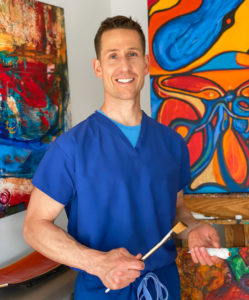
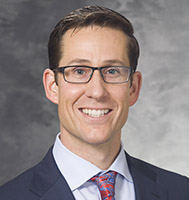
The ART of medicine
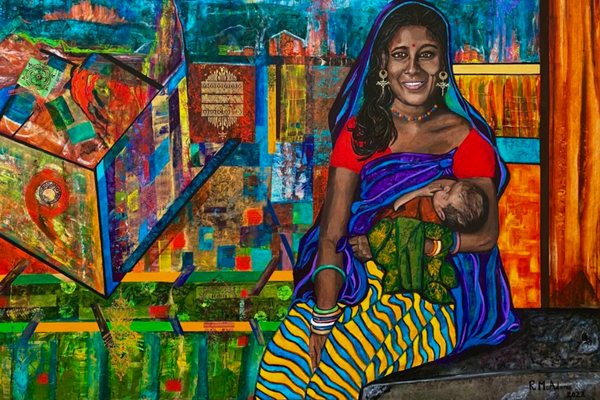
Advocacy for Neonatal Health and Equality
Advocacy extends beyond our home.
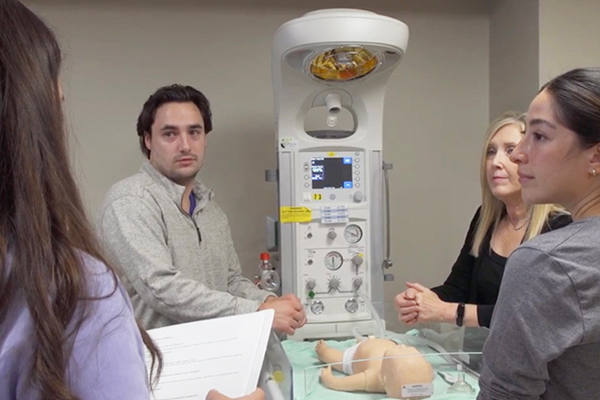
Research
Perinatal brain injury can be devastating to babies and to their families. My hope is that through research, we can understand ways to prevent brain injury in babies and treat babies with brain injury to help optimize their neurodevelopmental outcomes.
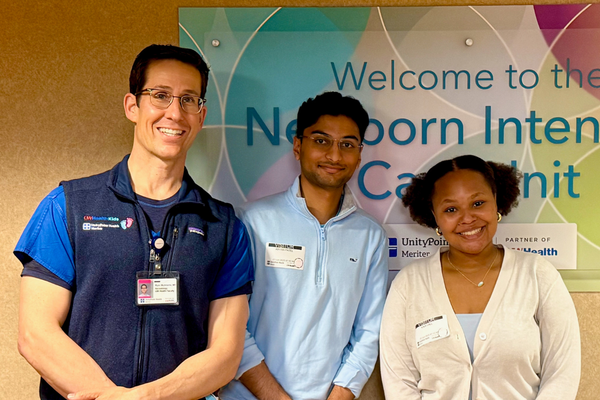
Teaching and Training
If everyone is better trained, our tiny patients will do better.
Research highlight: Artificial Intelligence (AI) in Neonatal Care
In the NICU, we deal with a vast and often overwhelming amount of data. The health and well-being of critically ill infants hinge on the accuracy and timeliness of our decisions. Despite the sea of information available to us, traditional decision-making methods sometimes fall short, leading to preventable medical errors.
To advance neonatal care, we need to find the best ways to integrate AI into our approach. AI isn’t just about computers; it’s about enhancing the way we think, reason, and continuously improve. Here’s why AI is transforming neonatal health care:
- Advanced Learning: AI grows and adapts using progressive learning algorithms. It learns from patterns and improves over time.
- Deep Data Analysis: With its capability to delve deep into complex data, AI offers insights that might be missed with traditional methods.
- Reliability: AI can handle high-volume tasks efficiently, consistently, and without fatigue, ensuring that every data point is considered.
- Machine Learning in Neonatal Care: A pivotal part of AI, machine learning, focuses on using data and iterative processes to learn specific tasks without explicit programming.
We are at the forefront of this exciting intersection of neonatology and AI, striving to provide the best care for every infant.

As a member of Neonatal Machine Learning and Innovations, Development, and Artificial Intelligence (NeoMIND-AI), we seek to to leverage the power of artificial intelligence (AI) to enhance the quality and precision of clinical care for neonates, in order to create a future where neonatal care is more personalized, efficient, and effective, and where every child has the best possible start in life.
This is an accordion element with a series of buttons that open and close related content panels.
Selected publications related to A.I.
McAdams RM, Kaur R, Sun Y, Bindra H, Cho SJ, Singh H. Predicting clinical outcomes using artificial intelligence and machine learning in neonatal intensive care units: a systematic review. Journal of Perinatology 2022 May 13.
Singh H, Kusuda S, McAdams RM, Gupta S, Kalra J, Kaur R, Das R, Anand S, Kumar Pandey A, Cho SJ, Saluja S, Boutilier JJ, Saria S, Palma J, Kaur A, Yadav G, Sun Y. Machine Learning-Based Automatic Classification of Video Recorded Neonatal Manipulations and Associated Physiological Parameters: A Feasibility Study. Children (Basel). 2020 Dec 22;8(1):E1. doi: 10.3390/children8010001.
Singh H, Cho SJ, Gupta S, Kaur R, Sunidhi S, Saluja S, Pandey AK, Bennett MV, Lee HC, Das R, Palma J, McAdams RM, Kaur A, Yadav G, Sun Y. Designing a bed-side system for predicting length of stay in a neonatal intensive care unit. Scientific Reports. 2021 Feb 8;11(1):3342. doi: 10.1038/s41598-021-82957-z.
Sun Y, Kaur R, Gupta S, Paul R, Das R, Cho SJ, Anand S, Boutilier JJ, Saria S, Palma J, Saluja S, McAdams RM, Kaur A, Yadav G, Singh H. Development and validation of high definition phenotype-based mortality prediction in critical care units. JAMIA Open. 2021 Mar 25;4(1):ooab004. doi: 10.1093/jamiaopen/ooab004.
Research News
Ryan McAdams awarded Meriter Foundation grant
The Meriter Foundation awarded Ryan McAdams, MD, professor in the Divisions of Neonatology and Newborn Nursery and Global Pediatrics, a $35,000 grant for his project, “Saving Babies with Virtual Reality: Transforming Neonatal Resuscitation.” This one-year …
January 27, 2026
Pediatric Neuromodulation Laboratory awarded ICTR Translational Basic and Clinical Research Pilot Award
The Pediatric Neuromodulation Laboratory at the Waisman Center received a $50,000 Translational Basic and Clinical Research Pilot Award from the UW Institute for Clinical and Translational Research (ICTR) to advance early motor rehabilitation in infants …
December 30, 2025Bernadette Gillick and Ryan McAdams awarded NIH grant to study novel non-invasive brain stimulation intervention in neonates with impaired oral feeding
Bernadette Gillick, PhD, MSPT, PT, professor, Division of Developmental Pediatrics and Rehabilitation Medicine, and Ryan McAdams, MD, professor, Divisions of Neonatology and Newborn Nursery and Global Pediatrics, and their teams were awarded Anderson National Institute …
December 2, 2025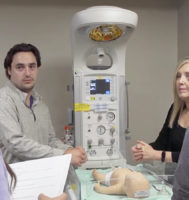
Neonatal Education Simulation and Training Center opens at UnityPoint Health – Meriter
UnityPoint Health – Meriter opened the Neonatal Education Simulation and Training Center (NEST) to educate and train medical professionals in newborn care. The NEST provides a space for learners to practice and discuss their performance …
November 11, 2025Designing for Downstream: The Long Shadows of Innovation
Speaker: Ryan McAdams, MD, professor, Divisions of Neonatology and Newborn Nursery and Global Pediatrics, Department of Pediatrics
October 23, 2025- More McAdams Research Group News posts