It’s a two-month well-child check. After the usual questions about feeding and sleep, Andrew Lewandowski, DO, asks the parents one more: any concerns about the environment, or about climate change and their baby’s health? Often the answer is no. So he offers two things to keep in mind over the summer. Babies don’t regulate their body temperature the way adults do, he explains, so on days above 90 degrees, it helps to stay in the shade or air conditioning and to offer feedings a little more often. And because infants breathe in a larger dose of air pollution than adults do, when the air quality index reaches the range labeled “unhealthy for sensitive groups,” this baby counts as a member of a sensitive group. The whole exchange takes less than a minute. For Lewandowski, that minute is the point.
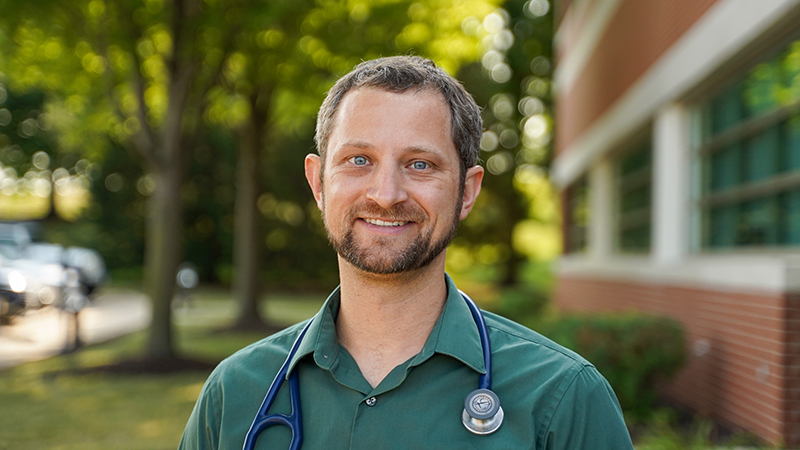
An assistant professor in the Division of General Pediatrics and Adolescent Medicine, Lewandowski joined the Department of Pediatrics in June 2025 after 10 years as a pediatrician at Group Health Cooperative of South Central Wisconsin. He is, by his own description, “essentially a Madisonian” — born in Ohio, here since he was 15 — with a UW undergraduate degree, a medical degree from Rocky Vista University College of Osteopathic Medicine in Colorado, and a residency in this Department of Pediatrics. A lifelong love of the outdoors first pointed him toward ecology and conservation; medicine, and later wilderness medicine, let him keep one foot in that world. His clinical interests now live at the intersection of pediatrics, climate change and health, and the wilderness medicine elective he has helped teach since 2013.
That intersection is the strong foundation of his climate health advocacy and clinical practice. Lewandowski has been giving talks and counseling patients about climate and health since 2019, and he has published the results. His work rests on a simple, unsettling premise: the modern practice of medicine was built for a world that no longer exists.
“All of the diagnostic and treatment guidelines were predicated on the assumption that our climate is stable,” he said. “Now that the climate is not stable, we need to adjust the ways in which we diagnose and manage disease to take that into account.” Seen that way, climate is not an optional wellness addition; instead, it’s a new and necessary variable to address in ordinary care. It shows up as longer allergy seasons, worse air quality, more intense heat, and ticks arriving earlier and in greater numbers.
His method for the exam room is deliberately modest. In a recent chapter for Pediatric Clinics of North America, Lewandowski and his co-authors frame a patient’s vulnerability as a plain equation: exposure to a climate hazard, plus individual sensitivity to it, minus the capacity to adapt. Naming a family’s exposure, connecting it to a child’s specific sensitivity, and then offering a concrete way to adapt: that action, Lewandowski said, is counseling any provider can do in under a minute.
The examples are pointedly undramatic. A child with allergic rhinitis coughing through longer pollen seasons, sleeping poorly, and struggling at school. A five-to-nine-year-old — the age group of highest Lyme risk — who wants to skip the tick check. An infant on a smoky day whose parents could improve their indoor air with a box fan and a HEPA filter rather than with an expensive air purifier. “You’re doing the same anticipatory guidance, the same counseling,” he said, “but you’re also letting them know this is getting worse because of climate change, and here’s what we can do about it.”
What makes the approach work, he argued, is not expertise so much as trust. Lewandowski pointed to the COVID-19 vaccine: patients asked his opinion even though national experts had spoken. “I’m their trusted messenger,” he explained. “They care what you think.”
The same holds for climate. “My caring about your child is not political,” he said. It’s a line he returns to often. His own first study, published in 2021, backs him up: families who received this counseling “didn’t run for the hills,” he reported. If anything, they appreciated it.
He knows the hesitation is real. In his writing he calls it a “fear of innovation.” It’s the worry that raising a charged topic will backfire. He notes, however, that the American Academy of Pediatrics (AAP) first urged pediatricians to work climate into their anticipatory guidance in 2015. “Here we are, 11 years past that recommendation,” he said, “and we’re still not doing it.” The professional consensus, he added, is not in doubt: the AAP, the American Medical Association, and more than a hundred health organizations have called climate change a health emergency.
Outside the clinic, Lewandowski helped found Healthy Climate Wisconsin, now one of the country’s leading climate-and-health nonprofits; served as a content specialist to the Wisconsin Governor’s Task Force on Climate Change; and co-led the team that built the American Board of Pediatrics’ first maintenance-of-certification activity on climate and health counseling. In January, he joined Wisconsin Public Radio’s “The Larry Meiller Show” to discuss climate-smart health care, where he kept the message squarely on patients: “The underlying goal is to provide good quality, safe medical care for individuals and help them achieve and maintain health.”
That may be the reframing he most wants families to hear. Climate change, he said, “is just about as much about humans as it is about a polar bear on a shrinking iceberg.” Physicians have an obligation to tell patients how it affects them, and families have a right to know, and to learn how to adapt. “If you make it less about headbutting and more about problem-solving to keep their children safe,” he explained, “then it’s really not that scary.”
Photo by Kate Feldt/Department of Pediatrics