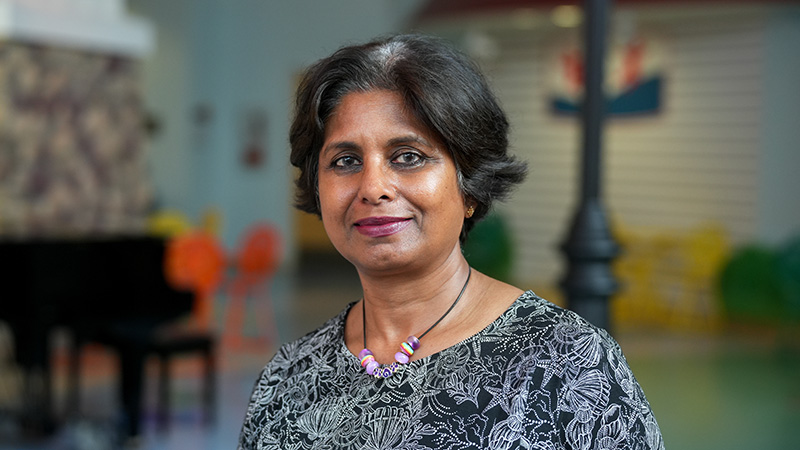
She once wanted to be an architect. Shardha Srinivasan, MBBS, MD, professor in the Division of Cardiology, instead built a career around something more intricate than any blueprint: a fetal cardiology program organized not only around a patient’s heart, but also including the whole family surrounding it. After more than two decades with the Department of Pediatrics and the University of Wisconsin School of Medicine and Public Health, Srinivasan will retire on September 30.
“You’re not just dealing with the baby’s heart; it’s the entire family,” she said of the work that has defined her career. As director of fetal cardiology services at American Family Children’s Hospital (AFCH) and UnityPoint Health – Meriter, and as physician lead for advanced imaging and three-dimensional echocardiography at AFCH, Srinivasan has spent her years in Madison caring for children with heart disease from before birth through early adulthood — and building the programs that make that care possible.
Her path to medicine began in India. As a young woman she wanted to be an architect but found that math wasn’t her strength. She gravitated instead toward the example closest to home: an aunt who was a respected physician at a time when there were few female doctors in India. “I used to look like her,” Srinivasan recalled, “and I grew up with this subliminal message that I was going to become a great doctor like her.” She earned her medical degree at Devi Ahilya University in Indore, completed a pediatric residency at Montefiore Medical Center at the Albert Einstein College of Medicine, a fellowship in pediatric cardiology at New York University, and a senior clinical fellowship in non-invasive cardiology at Children’s Hospital Boston, where she concentrated on cardiac MRI and fetal echocardiography.
Cardiology drew her because it challenged her. “It’s a beautiful subspecialty, this interplay between how the heart is formed and how the pressures behave,” she said. A gifted teacher during her training in India taught her to reason through each diagnosis, and the specialty never lost its hold on her. “Even with all the technology, it never gets old. There’s always something new to learn.” Pediatrics, she added, appealed to her because of children’s innocence: her young patients came to her with what life had dealt them — they had not yet had the chance to do anything harmful to their own health.
Srinivasan joined the UW faculty in 2001 and became director of fetal cardiology services the following year. Over the next two decades she built the program largely from the ground up. Because the University Hospital/AFCH site offered no onsite obstetric services, she designed a hybrid model with concurrent clinics at AFCH and Meriter, allowing the program to reach a far wider region. Under her direction the number of fetal echocardiograms roughly tripled, from a few hundred a year to more than 1,000, and fetal diagnoses now precede 40% to 45% of the division’s neonatal cardiac surgeries — up from 25% to 30% a decade ago. To coordinate care across the two hospital systems, she conceived and advocated for a fetal cardiac care coordinator position, created in 2019, which became a template for other services spanning the two systems.
Imaging has been the constant thread throughout her career. In 2017, when three-dimensional echocardiography was still used almost exclusively in adults, Srinivasan introduced the technology at AFCH, developed a structured training program for sonographers, and grew the service from four procedures to 28 in three years. She also served as physician lead for the multidisciplinary Fontan clinic, and for 15 years was also the physician lead for pediatric cardiology within the Neuromuscular Disorders Clinic. It’s the only certified Duchenne Care Center in Wisconsin.
“Dr. Shardha Srinivasan has been a cornerstone of UW Pediatric Cardiology for more than two decades, helping to build our program into the nationally recognized division it is today,” said Heather Bartlett, MD, professor and interim chief of the Division of Cardiology. “Her leadership in fetal cardiology, advanced imaging, outreach, education, and mentorship has expanded both the scope and quality of care we provide to children and families with complex heart disease. Beyond her many accomplishments, Shardha has been a steady and deeply valued presence in our division. She is, quite simply, part of the soul of UW Pediatric Cardiology, and her impact will be felt for years to come.”
Five Questions with Shardha Srinivasan, MD
How has your career surprised you, compared to how you had expected it to develop when you began?
Honestly, I’m not sure I began with a firm expectation, but I’m grateful it unfolded the way it did. When I finished my training here, I went back to India on my visa and landed at one of the country’s largest pediatric cardiac institutes. It was a crash course: an enormous range of defects and complexity. So when I came back to Madison, where we didn’t yet have a large surgical program, I spent a couple of years feeling adrift because I wasn’t seeing the complexity I’d grown used to. That’s when I decided to carve out something of my own. The thing I could never have predicted is the rebirth of the cardiac program, with the growth of the cardiothoracic surgical program alongside it. That has been a wonderful thing for all of us.
What do you consider to be your biggest achievement?
I like to solve things, and my biggest achievement here is the fetal cardiology program. When we started out without surgery, we had to do things differently. Building a core group — a program that cared for the whole family, for the mother as much as for the baby, and working across teams — that has been deeply satisfying. More recently, once that was well established, I turned my attention to developing the three-dimensional echocardiography program, which is quite advanced. It’s been very gratifying to watch the numbers grow and to see people support it. It really comes down to imaging: I’ve always been drawn to imaging, and fetal cardiology and then 3-D echo are what I’d point to.
What has been your largest obstacle to overcome?
It isn’t a single obstacle so much as something global. Fetal cardiology is inherently multidisciplinary: there’s a mother carrying a baby, the baby arriving at birth, the physicians present at delivery, the cardiothoracic surgeon. My biggest challenge has been communication: keeping the vision coherent across specialties and getting everyone to buy into it. It’s compounded by the fact that we work across two hospitals. The experience has deepened my faith in communication. Things break down when people can’t get to the table, but as long as you’re respectful and willing to talk, you can move forward. And it has to be “we” thinking rather than “me” thinking — shared goals and a shared vision. I’ve had wonderful support here; we have a great group of people.
What advice would you offer to new physicians just starting out?
Two things: a growth mindset and passion for what you do. The passion is what keeps you enjoying it, and the growth mindset lets you keep up, because there’s always something new. The other piece, which I didn’t do very well, is work-life balance. There are always things at work that feel as though only you can accomplish them, but that’s rarely true. Many people at work can do what you do; in your family, you’re the only one who can be you. I learned that lesson late.
Do you have specific plans for your retirement?
I have a short-term plan and a long-term plan. In the short term: six hours of sleep, working out five days a week, and tending my garden. In the longer term, I’ve become really interested in systems addressing safety and quality. I’ve always cared about quality, but I never had the tools to study it properly, so I recently finished a certificate course at Harvard and want to build on it as I step back from leadership. I am very fortunate to have an opportunity to do so as a senior cardiologist at Lurie Children’s Hospital, while continuing my work in fetal cardiology and education. It’s all a bit of self-rediscovery — a chance to refocus my career and my goals.
Are there any people you would like to thank?
Over the years I have learned a lot about unconditional love, compassion, strength, and resilience from the many families who have allowed me to be a part of their children’s lives. I am eternally grateful to them for allowing me this opportunity. It has been so rewarding to see these kids mature into young adults and find their own path in life. The kids often find it surprising to know that I have known them from before they were born!
The people we work with day in and day out really become a second family, and I wanted to thank the whole team both here at UW and at Meriter for making “work” so enjoyable and doable. UW is remarkable in the close working relationship between the clinicians and the researchers at the university. I have to acknowledge my amazing collaborators over the years; I have a learned a lot from them, and they have enabled us to apply some really cool technology to further patient care. Last but not the least, my family for their unconditional love and support.
Photo by Kate Feldt/Department of Pediatrics