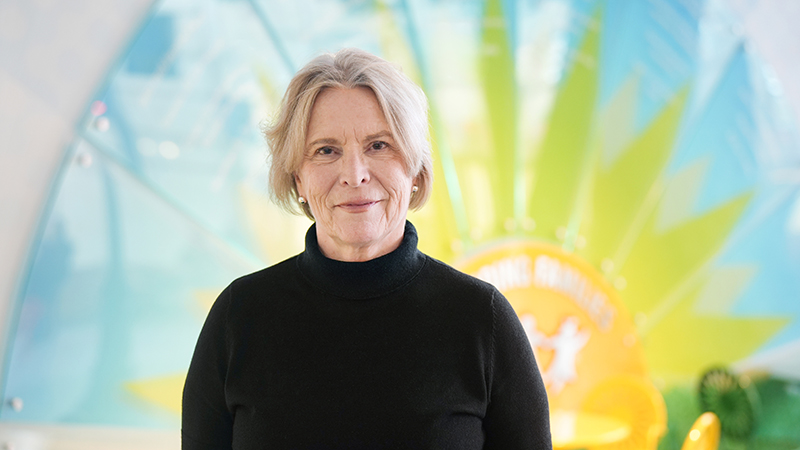
When Deirdre Burns, MD, associate professor in the Division of General Pediatrics and Adolescent Medicine, was completing her undergraduate degree in the early 1980s at the University of North Carolina at Chapel Hill, tuition wasn’t the barrier it is today. It was possible for students to “wander” a bit, to try out different subjects before committing. She was drawn to English literature and foreign languages. “My very practical father, though, advised me to study something that might result in employment,” she recounted. Burns earned a BA in economics. Her “wandering,” however, also took her to the extra-curricular experiences that opened the path to what became her life’s work.
During her undergraduate years, Burns began volunteering at the university hospital (now the UNC Hospitals), working as a teacher’s assistant for children with cleft palates, then eventually for children with other special needs. “I had known that I enjoyed working with children,” she explained. “This helped me decide to make a career of it. And led to my taking pre-med courses.” After a few years of taking postbaccalaureate classes at the University of North Carolina and working in research laboratories, she started medical school at UNC. “I loved medical school,” Burns said. “It was one of the best experiences of my life.”
Burns chose UW–Madison for her internship and residency. “I felt it was a very well-rounded program,” she explained. “Not too big, and I liked the fact that it offered a more balanced experience than some of the other programs I visited.”
She became a general pediatrician in the Division of General Pediatrics and Adolescent Medicine in 1998. She spent her entire career caring for pediatric patients on the east side of Madison, first at the now retired East Towne Clinic and most recently at the UW Health Union Corners Pediatric and Adolescent Medicine Clinic. She will retire on December 1.
Jeffrey Sleeth, MD, professor, clinical chief of the Division of General Pediatrics and Adolescent Medicine, and vice chair of primary care, had this to say about Deirdre Burns as she prepares to step into retirement from her long service:
“I’ve been very fortunate to work with Deirdre for many years here at the UW. Starting in the same residency class, we were together for our formative first intern year rotation on the inpatient unit at Madison General Hospital (now Meriter); and for the past six years we’ve been clinic colleagues again at the Union Corners clinic. She is an exceptionally talented pediatrician, bringing her deep knowledge of pediatrics and warm, empathetic style to every patient encounter. And as a partner, Deirdre is the consummate team player — always willing to step in to assist a colleague in need, and always willing to take on important roles in the division (e.g., pediatric e-consult program lead). I’m so pleased and excited for her to launch this next phase, but Deirdre will be truly missed by her colleagues, clinic staff, and especially by the patients and families she has cared for over her amazing career.”
Five Questions for Deirdre Burns
How has your career surprised you, compared to how you had expected it to develop when you began?
I am surprised by the change in scope of practice of a primary care pediatrician. When I first started out as a general pediatrician in Madison, I took care of complex patients myself and directed the care of my hospitalized patients as well as newborns — sometimes rounding on patients in two hospitals before my clinic day started. Now, primary care pediatrics is very much an outpatient practice. Pediatric behavioral health has become a much larger part of practice than it was in in 1992.
What do you consider to be your biggest achievement?
The achievement of which I am most proud is having raised a wonderful, kind, and smart daughter, who throughout much of my career has been my North Star. That sounds very personal, but she influenced the way I care for my patients a great deal. I have really strived to take care of my patients in a way that I would want for my own child.
What have been the most challenging obstacles you’ve had to overcome?
I think I have been very lucky. I have a had a rich and rewarding career. Everyone has challenges, but fortunately in a supportive environment as we have in the Department of Pediatrics and my home clinics of Union Corners pediatrics and before that the East Towne Clinic, I always felt I had a supportive team around me. I would have to say that working through the COVID pandemic was the biggest challenge in so many ways, and it has really shaped the practice of general pediatrics as we know it now.
What advice would you offer to new physicians just starting out?
I would say to them to be sure and take time to enjoy the children who come to see you. Talk to them, be silly with them, and let yourself delight in who they are and who they become. There will always be charts to finish, MyChart messages to send, and problems to solve, but don’t let the work of pediatrics make you forget the joy and privileges of being a pediatrician.
Do you have specific plans for your retirement you’d like to share?
I have lots of plans — home projects, gardening, yoga, travel plans, and most importantly, spending time with family and friends.
Please let us know about any people you’d like to thank.
Thank you to all of the parents who trusted me with the care of their dear children, and thank you to my co-workers who have been so supportive. My husband, John, also deserves a huge thank you for putting up with my many late arrivals home at the end of the day!
Photo by Kate Feldt/Department of Pediatrics